
The Life Cycle and Social Roles of the Honey Bee
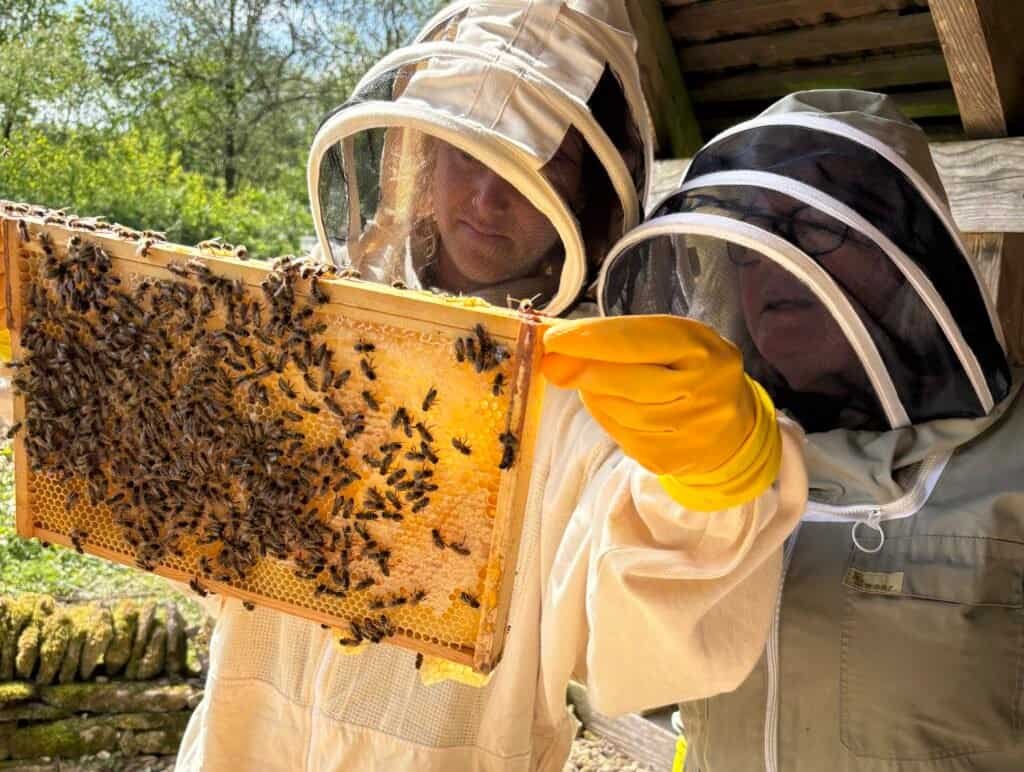
The honey bee colony is made up of worker bees, drones, and a queen. The female worker bees build wax, forage for pollen and nectar, nurse brood, and perform other activities inside and outside the hive. The male drone bees mate with queens from other hives during the queens’ nuptial flight. Besides procreation, drones may have more subtle influences on the bee colony, with studies suggesting that they help keep the brood warm when the workers are foraging, and also visit other hives, bringing with them pathogens which strengthen the overall bee population’s immunity. The queen, although genetically identical to a worker bee, has been fed more royal jelly throughout the larval stage, which helps her to develop her reproductive organs. A queen cell is also laid to face downwards and takes an elongated shape. Three to four days after the queen cell is capped, the worker brood add dimples to the queen cell, which make it appear like a peanut shell.
The drones live during the spring and summer, but are not necessary during the colder months, so the worker bees kick them out of the hive in the autumn, where they die. A drone can live up to three months. If a drone can fly high and fast enough to mate with a queen, it will die in the act. Drones appear noticeably larger than worker bees, partly because they have larger flight muscles, which allow them to hover for long periods in drone congregation areas and fly up to the queen. You will also notice larger eyes on the drones, which help them to spot the fast-moving queen and catch up with her.
At the height of spring and summer, a typical colony may be made up of 10–15% drones, although modern beekeeping practices can reduce the number of drones in a hive, as they are often seen as not directly benefiting honey production.
Beekeepers may add wax foundation with a hexagonal guide, which the worker bees use as a template when building comb. However, these cells are often sized too small for the queen to recognise them as suitable for laying drone eggs. Alternatively, beekeepers may add drone-sized foundation, but later remove the whole frame of drone brood.
The worker bees take 21 days to develop, and the drones take 24 days. These extra three days give more time for the pest, Varroa destructor, to develop and reproduce. These mites move into a bee cell just before it is capped by the worker bees, for a worker bee this happens on day 9, and for a drone this heppnes on day 10, so the worker bee is capped for 12 days while the drone is capped for about 14 days, thse extra two days, allow the varroa mites to reproduce one or two times more, and from this can increase their numbers throughh the hive, they feed on the bees fat body, and also create a vector for harmful and deadly diseases, such as deformed wing virus, and paralisiss.
Beekeepers typically treat honey bee colonies with oxalic acid and formic acid, and may also use synthetic miticides. These treatments are usually carried out early in the season, or after the honey has been taken off. Integrated pest management is also used, such as removing drone brood comb, or keeping a mesh floor so that mites can drop off and fall away from the colony.
Natural beekeepers may choose not to treat, hoping instead to develop colonies that are more resistant to varroa mites. These colonies may display varroa sensitive hygiene (VSH), whereby bees uncap and remove brood infested with varroa. They may also groom one another to remove mites, and in some cases damage the mites’ legs so that they cannot reattach to another bee.
Some natural beekeepers may also design bespoke hives with sloped floors, allowing mites and debris to fall out through the entrance. This is based on the idea that, once a varroa mite has fallen from a bee, it may struggle to climb back up into the colony, especially if the hive design helps carry it away from the cluster.
To be continued…
More to explore
 3 min read
Biodynamic Tree Paste
Read article →
3 min read
Biodynamic Tree Paste
Read article →
 25 min read
Therapeutic Education: Co-occuring Autism and Trauma, Sense of Balance, and Gardening
Read article →
25 min read
Therapeutic Education: Co-occuring Autism and Trauma, Sense of Balance, and Gardening
Read article →
 12 min read
Integrated and Diagnostic Ways of Knowing in the Student Study: A Reflexive Analysis informed by McGilchrist’s Hemispheric Framework
Read article →
12 min read
Integrated and Diagnostic Ways of Knowing in the Student Study: A Reflexive Analysis informed by McGilchrist’s Hemispheric Framework
Read article →