Therapeutic Education: Co-occuring Autism and Trauma, Sense of Balance, and Gardening
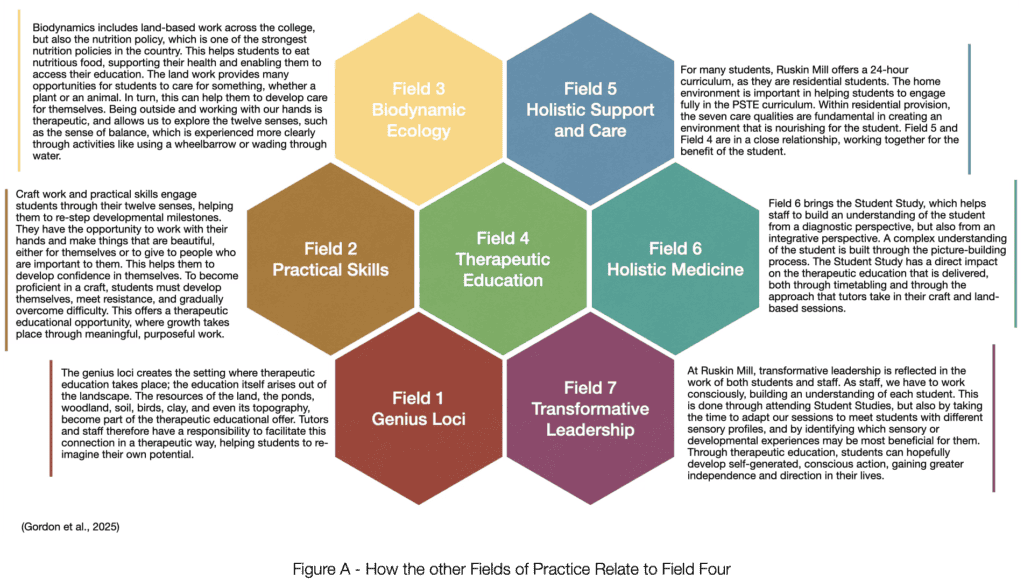
Field Four: Therapeutic Education is the keystone of the RMT’s seven fields of practice, and relates to the six other fields of practice (see Figure A). Field Four, attends closely to the twelve senses and the phases of human development (Gordon et al., 2025, pp. 90–109). Practical Skills Therapeutic Education (PSTE) engages students in a rich curriculum through crafts and land work that develop the senses, often beginning with the lower senses and gradually building towards the higher senses (Wiehl et al., 2020, pp. 32–46). This method requires educators to be well trained and attentive to each student, in order to individually tailor their curriculum and sessions, helping them to re-step developmental milestones. The environment, composed of the biodynamic farm organism, genius loci, and natural rhythms, provides a therapeutic base and sensory rich landscape for these activities to take place.
In this essay, I focus on the affordances of the land-based curriculum, specifically gardening, which I tutor, with a focus on wheelbarrow and wading in supporting students to develop their sense of balance and, in doing so, re-step key developmental milestones. I focus on students with co-occurring autism and trauma, as this is a frequent presentation among the students I work with at Ruskin Mill College (RMC). Individuals with autism spectrum condition have an increased risk of “encountering traumatic events, and developing traumatic sequelae” (Kerns et al., 2015, p. 3475).
Students come to RMT having often been failed by the education system. The term ‘barriers to learning’ which features in the question I am responding to implies that it is the student who has failed, rather than the system itself. Miles (as cited in O’Sullivan, 2026, p. 124) argues “Neurotypicals love to think autistic people are the problem but making us fit into your world is the real problem”. Ruskin Mill acknowledges this perspective and in the context of education adopts an individual, student-centred approach, seeking to meet each learner with an education that is both accessible and meaningful.
In my role, I am therefore confronted daily with contradictions that challenge my understanding of autism and require me to move beyond preconceived ideas. Even in the context of the sense of balance, I encounter many students who struggle with balance, while others display a remarkable sense of balance.
Thus, this essay will begin with an exploration of co-occurring autism and trauma as its first lens, considering how a sense of balance may be experienced within this cohort. It will then move to a second lens, examining the affordances of PSTE, specifically land-based work, including wheelbarrowing and wading, as a means of developing this sense of balance. From here, the discussion will consider how working with the sense of balance may support a re-stepping of early child development for students with co-occurring autism and trauma. Throughout, I will draw upon my own experiences as a gardening tutor for over four years, and observations gathered and informed by theoretical and practical sessions during the taught blocks.
Co-occurring Autism and Trauma
The distinction between an autism diagnosis and autism co-occurring with trauma is often overlooked (Kerns et al., 2015.) Therefore, focusing solely on autism spectrum condition, without reference to trauma, feels insufficient for this inquiry, particularly as I explore the relationships between barriers to learning, the development of a sense of balance, and early years developmental phases.
Kerns et al. (2015, p. 3480) note that “youth with an [autism diagnosis] are at an increased risk for almost every psychiatric comorbidity [except] PTSD in the majority of studies to date. [Which] is puzzling, particularly given the risks for increased exposure and poor response in this population”. This may indicate that an autistic diagnosis seems to create an umbrella which simply incorporates trauma, instead of understanding the complexities that co-occurring autism and trauma may generate for an individual. Kerns states that a “transactional relationship between trauma and ASD should be considered” as ASD may influence how an individual experiences trauma, trauma itself may influence how an ASD is presented.
Children with ASD are nearly twice as likely to experience four or more adverse childhood experiences than their predominant neurotype peers (Berg et al., 2016), and are also more likely to experience social isolation, academic difficulties, self-injury, and a decline in adaptive functioning (Kerns et al., 2015, p. 3480). When reading student profiles, or attending a student study it is evident to see that students with autism at RMC often have significant traumatic life events in their biography, which significantly impacts their presentation, many students have triggers which relate to traumatic experiences, and many have the experience of processing traumatic events in seemingly more complex ways then a predominant neurotype individual. Individuals with ASD may turn to “maladaptive coping strategies” (Kerns et al., 2015) as they try to cope with their trauma, but outwardly presents as an exacerbation of their autism profile.
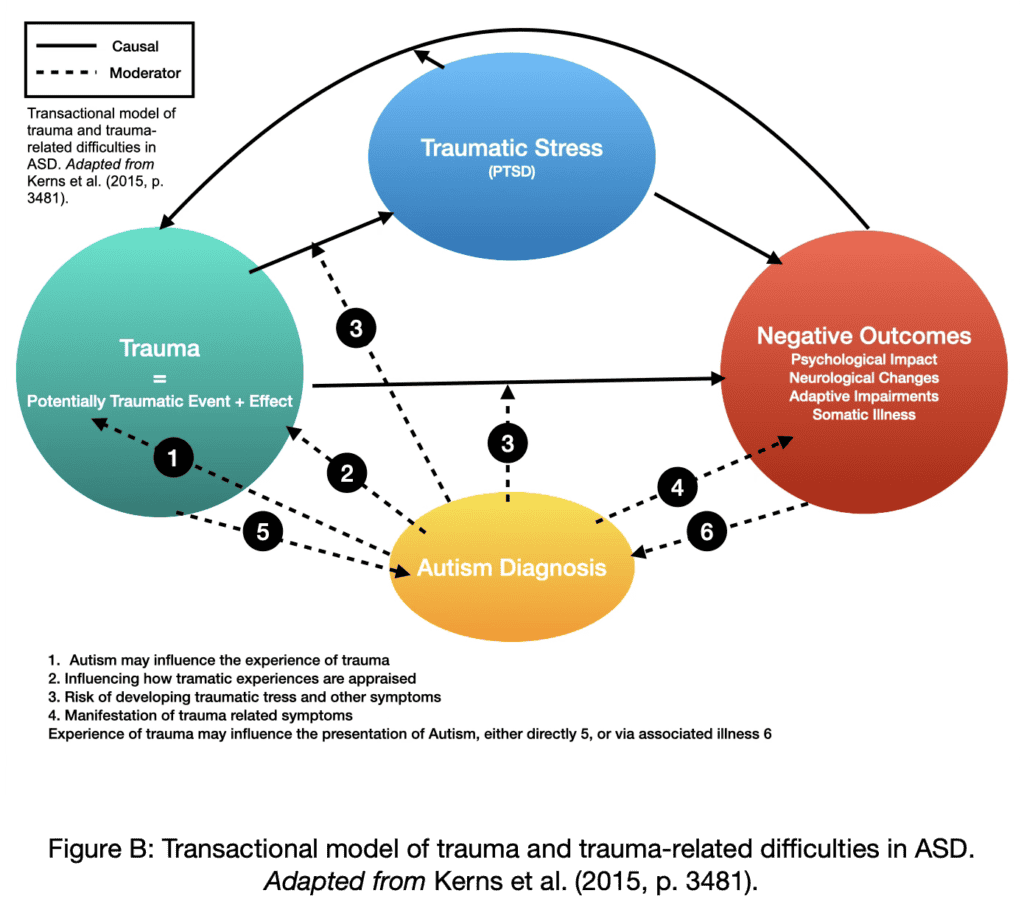
Many autistic individuals with co-occurring trauma may experience disruptions in early sensory-motor development, which can affect balance, coordination, and the way they navigate their environment. Kerns et al.’s transactional model of trauma (see Figure B) helps to frame this relationship, showing how autism may increase vulnerability to traumatic experiences, while trauma may in turn intensify some autistic experiences. In this sense, autism and trauma can interact dynamically, shaping the individual’s sensory experience, and sensory processing which makes balance difficulties an observable phenomenon (Kerns, 2015.)
Sense of Balance
The sense of balance is one of the twelve senses identified by Rudolf Steiner (1966), extending beyond the conventional understanding of five senses to include inner bodily forms of perception. The sense of balance could be understood in contemporary terms as equilibrioception which is the sensory process by which the body perceives balance and orientation (Chisari et al., 2024; Fuchs, 2018). The body does this through the vestibular system, proprioception and sensory integration (Chisari et al., 2024).
The vestibular organ is located in the inner ear and detects head movement and orientation relative to gravity; it is how we “know what left, right, front, back, up, and down are” (Soesman, 2023, p. 43; Steiner, 1966). The vestibular organ contains three semicircular canals, positioned roughly at right angles to one another and corresponding to the three planes of space (Gordon et al., 2025, pp. 61-63). These canals detect head movement and send signals to the brain, contributing to balance and spatial orientation (Alila Medical Media, 2022). Wiehl et al. (2020) illustrate this through the example of reading while moving the head: “if you read and…shake your head, you are still able to read… [however] if you hold your head still… and shake the book at the same speed, reading becomes impossible” (p. 37).
In maintaining balance and orientation, the vestibular system works in coordination with proprioception, which provides awareness of body position and movement (Peña et al., 2021). Vision and hearing also contribute to balance by offering external spatial reference points and environmental cues (Chisari et al., 2024). This can be observed in the increased difficulty of standing on one leg with the eyes closed, where the absence of visual input reduces stability (Chisari et al., 2024; Memari et al., 2014; Stins & Emck, 2018). The sense of touch also contributes to balance by providing feedback from the ground and supporting bodily orientation, demonstrating how multiple sensory systems are interwoven in maintaining equilibrium; no sense works in isolation (Gordon, 2026). Many autistic individuals experience differences in sensory integration, which may contribute to difficulties with balance (Memari et al., 2014; Stins & Emck, 2018).
Autistic individuals often experience sensory input differently from predominant neurotypes. These differences may include sensory blending, sometimes described as synaesthesia, as well as variations in perceptual experience. Many autistic individuals are also either hypo-sensitive or hyper-sensitive across different senses, including the vestibular system (Beardon, 2022, pp. 48–67). As a result, some individuals may seek out intense vestibular stimulation through activities like trampolining or roller coasters in order to stimulate the vestibular system, while others with a hyper-sensitive vestibular system may opt for slow movement in order not to stimulate their vestibular system in ways that become overwhelming or lead to feelings of vertigo. Beardon (2022) suggests that autistic individuals have a greater tendency to be hypovestibular, which leads to a need for movement and also stimming (Beardon, 2021). This need for vestibular stimulation is fundamental as one autistic individual describes “if I remain still, I feel as though I am in a continuous free fall and completely out of balance…and lack the capacity to focus and concentrate on anything else around me…but if I get to rock…I regain my equilibrium and it sort of reboots my system—it feels tremendous” (Aria, as cited in Beardon, 2020, p. 102).
The vestibular system forms one aspect of the sense of balance, as in order to balance in space we need to be aware of where our body is and what it is doing through proprioception. One lived account states, “my balance is rubbish, for example; I simply have to look at my feet to know where they are going, otherwise I just feel like I’m floating uncontrollably. I’m so glad for my yoga classes; they make me feel so much more grounded than before” (Gem, as cited in Beardon, 2020, p. 101).
Autism Spectrum Condition is associated with observable movement differences (Peña et al., 2021; Stins & Emck, 2018). As Memari et al. (2014) note, “children with ASD demonstrated delayed walking, a parkinsonian-type pattern, short steps, and asymmetrical gait” when compared to neurotypically developing children. Lotan and Weiss (2026) report that 86.9% of children and adolescents with Autism Spectrum Disorder (ASD) experience physical coordination difficulties. Difficulties with postural control may further affect autistic children’s wider experience on a daily basis (Oster & Zhou, 2022), including heightened anxiety, challenges with social interaction, and reduced participation in peer play or sports (Satiansukpong & Daranee, 2019; Stins & Emck, 2018). Static posturography is used in research to measure functional balance, bodily coordination, and postural stability. Autistic individuals show increased postural sway “when standing on foam or closing eyes” (Chisari et al., 2024, p. 2), when compared to predominant neurotype individuals.
This suggests that vestibular and proprioceptive activities may offer one way of supporting these difficulties. “Vestibular activities, such as swinging, spinning, bouncing or movements that involve changes in head and body orientation can enhance spatial awareness, postural control, and overall sensory integration” (Eri̇k et al., 2025, p. 2). As Satiansukpong and Daranee (2019) put it, “good control of body movement emerges from the interaction of three important systems: the person, activity or task, and environment” (p. 2). For autistic individuals with co-occurring trauma, this interaction may be especially complex, as sensory, perceptual, cognitive, and emotional differences can make visual, proprioceptive, and vestibular organisation more challenging, resulting in poor balance in many circumstances.
Motorised Elephant-Assisted Therapy Program
When narrowing my research to the literature on vestibular therapies for autistic individuals, I found several papers exploring nature-based therapies, such as horse riding, where “the horse’s gait induces continuous changes in the rider’s centre of gravity requiring immediate positional readjustments… [and] is a motivating and highly structured activity” (Vives-Vilarroig et al., 2025). However, I was struck by the amount of research into computerised balance games (Peña et al., 2021), and simulations. In one example, three occupational therapists in Thailand built a motorised elephant to simulate vestibular and proprioceptive activities, with the aim of helping autistic individuals develop balance (Satiansukpong & Daranee, 2019).
The motorised elephant then moved forwards and backwards, and once participants became familiar with this movement, the movements are made more complex, including “circular, rectangular, and diagonal movements” (Satiansukpong & Daranee, 2019, p. 4). As participants became more confident, games were introduced on the elephant, such as throwing balls and playing with peers.
The study found that “60% of parents reported that the experimental group gained better postural control and balance in real-life activities” (Satiansukpong & Daranee, 2019, p. 6). The authors also acknowledge that motivation is key to engaging autistic individuals in activities that promote movement and balance. In this study, the novelty of the motorised elephant appeared to support engagement, while the use of an “animal robot” reduced physical and emotional stress that may come with the use of a real animal (Satiansukpong & Daranee, 2019, p. 2).
This study shows how balance can be developed through structured sessions that feel safe, motivating, and novel. However, sport, craftwork, and daily activities also have the affordance of developing balance; the key factor is motivation. Through the PSTE curriculum, students are able to encounter real land-based experiences, with real unpredictability and subtlety. PSTE activities must therefore be engaging, while unnecessary distractions, such as overstimulating noise, visual clutter, or strong smells, should be minimised. In this way, students can begin to build their sense of balance within a simplified environment, before gradually developing greater resilience and confidence.
Meaningful Land Work to Develop a Sense of Balance
Land-based activities within PSTE may provide a means of re-engaging disrupted early sensory-motor development, particularly for autistic individuals with co-occurring trauma, through the development of balance. Such activities help students become more fully embodied, bringing them into a more secure relationship with their own bodies, with gravity, and with the surrounding environment (Etherington, 2012).
During the taught block, I observed a land-based session at another provision. Ethical approval and permissions for observation are provided (see Appendix A). Although the session was valuable, it took place mainly within a garden classroom and therefore offered limited insight into the students direct relationship with the land, movement, and balance, which highlighted that the sense of balance is most clearly encountered through engaging the body with the environment rather than through classroom-based activity alone (see Appendix B).
In the weeks following this observation and taught block, I was able to recognise the foundational senses more acutely in my own sessions, drawing not on individual student case studies, but on broader observations of students engaging in gardening activities over many years. My developing understanding of autism and sensory integration allowed me to come a little closer to the student experience, and to recognise how many activities in the garden help to develop the senses.
I am a tutor of Valley Landscape at RMC, where I work with students on the land through tending the landscape, growing vegetables and flowers in the market garden, caring for chickens, and maintaining the mill ponds. The sessions are well suited to working with students with co-occurring autism and trauma, as the activities allow them to engage directly with their lower senses.
My workshop is held within the valley, with steep banks to the east and west, and large ponds to the north and south. The running stream and path bring a feeling of flow, and space to an otherwise well-contained environment. Valley Landscape provides many opportunities to help students develop their lowest senses, and most viscerally their sense of balance. This makes my own experiences and observations of students that I work with key insights for my research, helping me to recognise how a sense of balance can be developed through land-based activities to help students with co-occurring autism and trauma re-step their early developmental milestones.
Gardening tasks can provide students with opportunities to re-step early developmental stages through age-appropriate and meaningful work. At the same time, the terrain of the garden can be difficult for students with vestibular and proprioceptive difficulties to navigate. Relevant literature suggests that gardening work and nature-based experiences can “improve balance, agility, and co-ordination” for autistic individuals (Barakat et al., 2019, p. 355).
I argue that autism with co-occurring trauma needs to be more widely recognised within special needs education. Within my own land-based sessions, two activities are particularly important for developing the sense of balance for this cohort, namely wheelbarrowing and wading. Many gardening activities develop the vestibular and proprioceptive systems, including digging, broadforking, planting, and pruning. However, as entry points for developing balance, wading and wheelbarrowing are particularly fundamental for many students.
Wheelbarrowing
Balance is encountered first through walking, especially through the varied terrain of a garden. For students with sensory challenges, moving through this environment may require significant energy, as they must process the surrounding landscape while also organising their own body position within it. This challenge is deepened when students begin to carry objects such as plant pots, tools, buckets, or watering cans, as these introduce additional demands of weight, resistance, and distribution. Many students initially find it difficult to hold a watering can without the water pouring out, as the shifting weight of the water requires them to continually adjust their posture, grip, pace, and direction.
From navigating the environment through walking, and then carrying objects, the next leap in balance comes with the wheelbarrow, which is often the unsung hero of a therapeutic garden. The wheelbarrow provides immediate and non-verbal feedback, allowing students to perceive imbalance directly through the movement of the tool, and how it feels. It requires the student to coordinate both sides of the body, judge weight, direction, speed, and space, and continually adjust posture in response to the terrain.
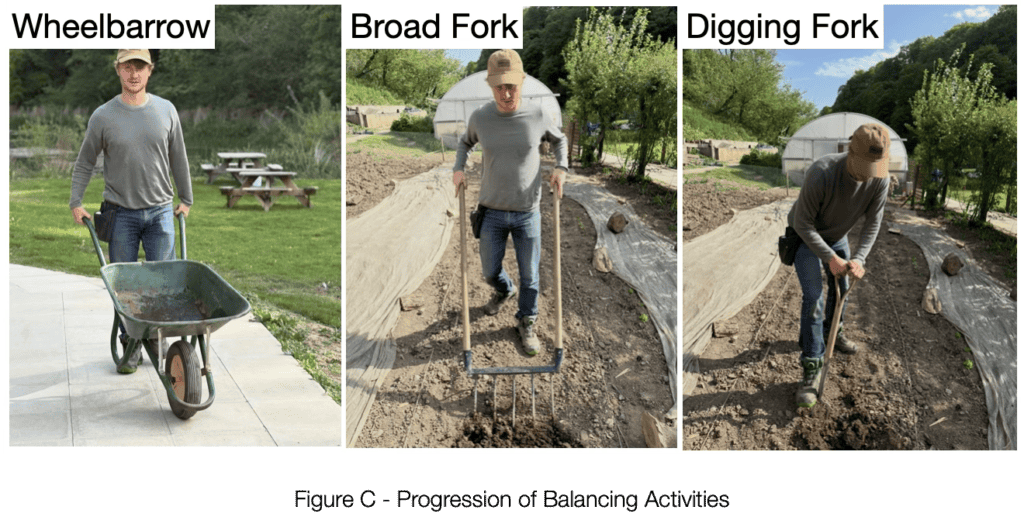
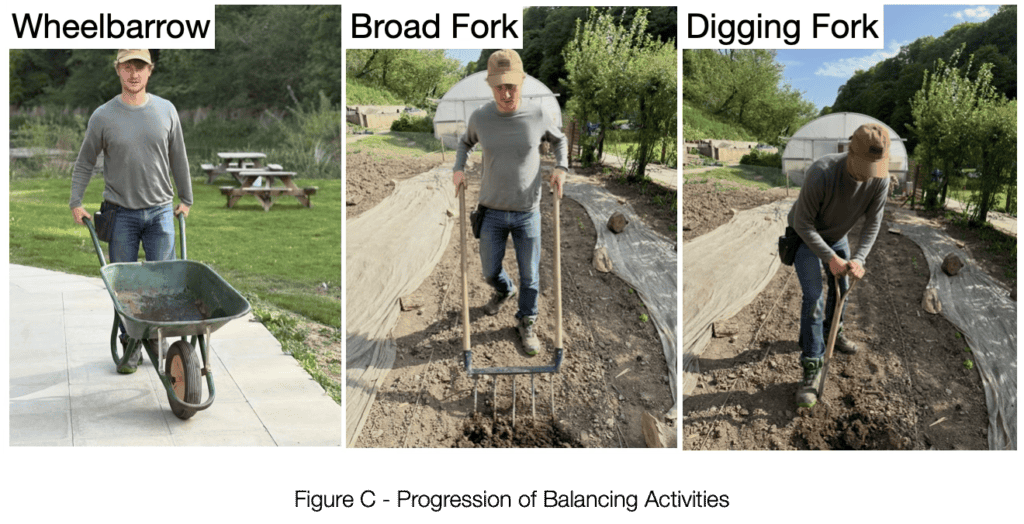
From wheelbarrow, I see a natural progression onto broad forking (see figure C), whereby balance becomes more vertical and rhythmical, requiring the student to place both feet, shift body weight, and press downward into the soil. Balance can then be refined further through the use of a digging fork, where the body must coordinate one-sided pressure, levering, lifting, and turning. Using a digging fork requires a lot more coordination, and the ability to cross the midline. From here, the activities in the garden may develop into raking, then hoeing, gradually moving from gross motor work to the delicate task of transplanting seedlings, where balance is applied in fine motor skills. A common observation occurs when the wheelbarrow wheel becomes stuck on a bump. If needed, I can step in and assist, but more often, by holding back, I am able to observe the student problem-solving. They may change their position and pull the wheelbarrow over the bump rather than continuing to push it. This demonstrates an emerging understanding of the environment, the position of the wheelbarrow, and the bodily movements needed to move it forward.
Half of autistic individuals were found to have hypotonia, meaning the muscles have less tension and are less responsive to movement, often resulting in decreased postural stability and difficulties with balance (Ming et al., 2007, p. 566). Wheelbarrowing supports muscle activation, postural control and functional strength, and as a tutor I am able to adapt the weight of the wheelbarrow for different abilities, and levels of muscle tone. Gardening sessions, and the land-based sessions promote movement and physical activity, which have many health benefits, Liang et al. (2020) found that children and adolescents with autism spectrum disorder engage in lower levels of physical activity when compared to predominant neurotype peers. The wheelbarrow provides an excellent entry point for physical activity which helps build muscle tone, while helping students engage in meaningful movement and balance, which “generates a sense of comfort” (Gordon, 2026, Slide 12).
With hypotonia, students may find it difficult to generate enough muscle tension to maintain balance. A student may initially struggle to push a wheelbarrow, as it requires the arms, shoulders, and core to engage in order to hold the handles and lift the back of the barrow so that the wheel fully takes the load. Commonly, students may push the wheelbarrow with the leg supports scraping along the ground, or the barrow may begin to veer to one side due to a lack of bodily coordination. Students may then be encouraged to pull the wheelbarrow behind them. This requires less tension in the arms and can be more manageable for some students; however, it also reduces the proprioceptive input gained from having the wheelbarrow in front of the body.
Dyspraxia is also frequent in autism and is characterised by difficulties in motor planning and coordination. In this sense, the wheelbarrow offers a fixed frame through which students can practise organised movement. Holding the handles gives the body a clear structure to work with, while the task itself requires the student to judge direction, speed, weight, terrain, and space. The wheelbarrow therefore becomes more than a practical gardening tool; it becomes a therapeutic object through which balance, coordination, proprioception, and purposeful movement can be developed.
Wading
RMC is fortunate to include a historic fish farm and large mill ponds, which once powered the cloth mills. Many autistic students naturally gravitate towards water. The valley is supplied with flow form water features, which bring calming sounds to the landscape and display an expansive and contractive movement that can be meditative to observe.
As an apprentice, I participated in fish farm sessions for a couple of years, and I now incorporate wading into many of my Valley Landscape sessions. Often, we enter the ponds under the pretext of cleaning flow forms and removing pond weeds, which gives the activity a meaningful quality. However, it is the feeling of being in the water, particularly while wearing waders, that brings a held and grounding quality and awareness of one’s balance.
Similarly to the feeling offered by a weighted blanket used in Occupational Therapy, the water presses against the waders, creating a feeling of pressure around the body. Once in the water, students then have to walk through it. On warm days, the water is often crystal clear, as it is fed by spring water; however, as students and staff move through it, silt is quickly stirred up and the water becomes murky. Students then have to navigate the ponds by feeling for stones and objects with their feet.
Vestibular and proprioceptive information is received more gradually, allowing students to encounter themselves, the water, and the ripples created by their own movement. For many students, this brings a kind of sensory simplification, enabling them to regulate through the water. Some students may need support when walking through the pond, especially those with dyspraxia or hypotonia, as these can lead to sudden or unstable movements and increase the risk of water entering the waders.
In waders, movements are slower, as students push against the weight and resistance of the water. They also have to pay close attention to every movement they make, becoming aware of the surface beneath their feet. For students with co-occurring autism and trauma, entering the pond can help regulate the body and bring a sense of balance. The water and the waders provide support, while the sensory feedback stimulates the body in a grounding way. The waders also provide a feeling of being “held” through hydrostatic pressure (Lotan & Weiss, 2026), without the student needing to be physically held by another person, which may feel intimate or uncomfortable for some autistic individuals. In this way, the water environment simplifies sensory input while simultaneously enhancing proprioceptive feedback, creating optimal conditions for the development of balance.
While these activities offer significant therapeutic potential, they rely heavily on practitioner sensitivity and environmental conditions. Without careful attunement and individualisation, tasks such as wheelbarrowing may reinforce poor movement patterns, while wading may overwhelm students with sensory sensitivities.
Re-stepping the First Seven Years
Within Steiner’s picture of child development, the first seven years are especially concerned with the development of the physical body and the lower senses: touch, life, movement, and balance (Steiner, 1990). These senses provide the foundation for bodily security, orientation, and later social and cognitive development. For students with co-occurring autism and trauma, these early foundations may be disrupted or insecure, particularly where sensory integration, postural control, and confidence are affected.
Wheelbarrowing and wading therefore offer opportunities to re-step aspects of this early development in an age-appropriate way. Rather than returning students to childhood activities, PSTE offers meaningful adult work through which foundational sensory-motor processes can be revisited and strengthened. Through meeting weight, resistance, water, gravity, and uneven ground, students can gradually build a more secure relationship with their own body and with the world around them.
Research-Informed Practice: How This Discussion Relates to My Professional Practice
In my role, I assess prospective students each week. These students spend a morning in my session, giving both the student and RMC an opportunity to see whether the provision is a good fit. Instinctively, I often incorporate wheelbarrowing into the session, as it provides a diagnostic tool through which I can learn a great deal about how the student relates to balance, movement, coordination, and physical work. This research has clarified why the wheelbarrow is such a valuable assessment tool. It has also helped me understand why students with autism and co-occurring trauma often find indoor sessions difficult and instead gravitate towards land-based work, where the foundational senses can be engaged more directly. Over time, students who develop through wheelbarrowing, wading, and other gardening tasks often show progress in gross motor movement, confidence, and bodily awareness. As they become more regulated, they may also become more able to engage fine motor skills. This can open up wider areas of the curriculum, including craftwork, where the middle and higher senses are more directly engaged.
Conclusion
Balance is a foundational sense. It affects how we engage with ourselves and with the environment around us. For individuals with autism and co-occurring trauma, there can be a profound sense of imbalance in their experience of the world. Activities that may appear easy for predominant neurotype individuals can present significant challenges for autistic individuals, particularly where there are difficulties with hyper- or hypo-sensitive vestibular systems, sensory integration, and proprioception.
Through meaningful land-based activities, students engage their bodies, building muscle tone, muscle memory, and awareness of themselves in space. Wheelbarrowing and wading offer two foundational tools through which autistic students with co-occurring trauma can become more accustomed to their relationship with balance and gradually develop it. In this way, these activities are not simply practical tasks, but therapeutic opportunities through which students can meet gravity, resistance, movement, and uncertainty in a supported and meaningful way. Through repeated engagement, they can help students strengthen their lower senses, come more fully into embodiment, and gradually develop the balance needed to orientate and participate more confidently in the world. Therapeutic education therefore identifies barriers to learning not as fixed deficits within the student, but as developmental goals that can be met and overcome through practice.
References
Alila Medical Media. (2022). The vestibular system, animation [Video]. YouTube. https://www.youtube.com/watch?v=ryGMI3SpxCE
Baladaniya, M., Baldania, S., Hait, A., & Choudhary, A. K. (2025). Dual-Task Gait and Balance Training Integrated With Sensory-Motor Interventions for Children With Autism Spectrum Disorder: A Comprehensive Narrative Review. Curēus (Palo Alto, CA), 17(9), e93268. https://doi.org/10.7759/cureus.93268
Barakat, H. A.-E.-R., Bakr, A., & El-Sayad, Z. (2019). Nature as a healer for autistic children. Alexandria Engineering Journal, 58(1), 353–366. https://doi.org/10.1016/j.aej.2018.10.014
Begum Ali, J., Charman, T., Johnson, M. H., Jones, E. J. H., & The BASIS Team. (2020). Early motor differences in infants at elevated likelihood of autism spectrum disorder and/or attention deficit hyperactivity disorder. Journal of Autism and Developmental Disorders, 50(12), 4367–4384. https://doi.org/10.1007/s10803-020-04489-1
Beardon, L. (2020). Avoiding anxiety in autistic adults: A guide for autistic well-being. Sheldon Press.
Beardon, L. (2021). Autism in adults. Sheldon Press.
Beardon, L. (2022). Autism in childhood: For parents and carers of the newly diagnosed. Sheldon Press.
Berg, K. L., Shiu, C.-S., Acharya, K., Stolbach, B. C., & Msall, M. E. (2016). Disparities in adversity among children with autism spectrum disorder: A population-based study. Developmental Medicine & Child Neurology, 58(11), 1124–1131. https://doi.org/10.1111/dmcn.13161
Bumin, G. (2015). Occupational therapy in autism. In Autism spectrum disorder: Recent advances. IntechOpen.
Celebrate Neurodiversity – PDA Dad UK. (n.d.). Autism, pathological demand avoidance, SPD and the vestibular system [Video]. YouTube. https://www.youtube.com/watch?v=-V5LLSu7T6Q
Chisari, D., Vitkovic, J., Clark, R., & Rance, G. (2024). Vestibular function and postural control in children with autism spectrum disorder. Journal of Clinical Medicine, 13(17), Article 5323. https://doi.org/10.3390/jcm13175323
Dziuk, M. A., Larson, J. C. G., Apostu, A., Mahone, E. M., Denckla, M. B., & Mostofsky, S. H. (2007). Dyspraxia in autism: Association with motor, social, and communicative deficits. Developmental Medicine & Child Neurology, 49(10), 734–739. https://doi.org/10.1111/j.1469-8749.2007.00734.x
ECHO Autism. (n.d.). Transactional model of trauma [Video]. YouTube. https://www.youtube.com/watch?v=FaK5ywkDfhA
Eri̇k, E., Safran, E. E., & Şevgi̇n, Ö. (2025). Effectiveness of vestibular and proprioceptive exercises in reducing hyperactivity in children with autism spectrum disorder: A randomized controlled trial. Research in Autism, 123, Article 202543. https://doi.org/10.1016/j.reia.2025.202543
Etherington, N. (2012). Gardening for Children with Autism Spectrum Disorders and Special Educational Needs: Engaging with Nature to Combat Anxiety, Promote Sensory Integration and Build Social Skills (1st ed.). Jessica Kingsley Publishers.
Fournier, K. A., Hass, C. J., Naik, S. K., Lodha, N., & Cauraugh, J. H. (2010). Motor coordination in autism spectrum disorders: A synthesis and meta-analysis. Journal of Autism and Developmental Disorders, 40(10), 1227–1240. https://doi.org/10.1007/s10803-010-0981-3
Fuchs, D. (2018). Dancing with Gravity—Why the Sense of Balance Is (the) Fundamental. Behavioral Sciences, 8(1), Article 7. https://doi.org/10.3390/bs8010007
Gordon, A. (2026, March 30). The foundation senses [Presentation]. Field Centre.
Gordon, A., et al. (Eds.). (2025). Practitioner’s guide: PSTE. Ruskin Mill Land Trust.
Kerns, C. M., Newschaffer, C. J., & Berkowitz, S. J. (2015). Traumatic childhood events and autism spectrum disorder. Journal of Autism and Developmental Disorders, 45(11), 3475–3486. https://doi.org/10.1007/s10803-015-2392-y
Liang, X., Li, R., Wong, S. H. S., Sum, R. K. W., & Sit, C. H. P. (2020). Accelerometer-measured physical activity levels in children and adolescents with autism spectrum disorder: A systematic review. Preventive Medicine Reports, 19, Article 101147. https://doi.org/10.1016/j.pmedr.2020.101147
Lotan, M., & Weiss, M. (2026). Balance and Coordination Improvements in Children and Adolescents with Autism Spectrum Disorder (ASD), Resulting from a Hydrotherapy Intervention. Children (Basel), 13(1), 94. https://doi.org/10.3390/children13010094
Mansour, Y., Burchell, A., & Kulesza, R. J. (2021). Central auditory and vestibular dysfunction are key features of autism spectrum disorder. Frontiers in Integrative Neuroscience, 15, Article 743561. https://doi.org/10.3389/fnint.2021.743561
Memari, A. H., Ghanouni, P., Shayestehfar, M., & Ghaheri, B. (2014). Postural control impairments in individuals with autism spectrum disorder: A critical review of current literature. Asian Journal of Sports Medicine, 5(3), Article e22963. https://doi.org/10.5812/asjsm.22963
Ming, X., Brimacombe, M., & Wagner, G. C. (2007). Prevalence of motor impairment in autism spectrum disorders. Brain & Development (Tokyo. 1979), 29(9), 565–570. https://doi.org/10.1016/j.braindev.2007.03.002
Oster, L. M., & Zhou, G. (2022). Balance and vestibular deficits in pediatric patients with autism spectrum disorder: An underappreciated clinical aspect. Autism Research and Treatment, 2022, Article 7568572. https://doi.org/10.1155/2022/7568572
Peña, O., Cibrian, F. L., & Tentori, M. (2021). Circus in Motion: A multimodal exergame supporting vestibular therapy for children with autism. Journal on Multimodal User Interfaces, 15(3), 283–299. https://doi.org/10.1007/s12193-020-00345-9
Steiner, R. (1990). The riddle of humanity (Lecture VII, Dornach, 12 August 1916). Rudolf Steiner Press. Retrieved May 2, 2026, from https://rsarchive.org/Lectures/GA170/English/RSP1990/19160812p01.html
Steiner, R. (1966). The study of man: General education course. Rudolf Steiner Press. https://rsarchive.org/Lectures/GA293/English/RSP1966/19190829a01.html
Rumball, F., Happé, F., & Grey, N. (2020). Experience of trauma and PTSD symptoms in autistic adults: Risk of PTSD development following DSM-5 and non-DSM-5 traumatic life events. Autism Research, 13(12), 2122–2132. https://doi.org/10.1002/aur.2306
Thrive. (n.d.). Gardening and autism. Retrieved April 12, 2026, from https://www.thrive.org.uk/get-gardening/gardening-and-autism
Satiansukpong, N., & Daranee, S. (2019). Effect of motorized elephant-assisted therapy program on balance control of children with autism spectrum disorder. Occupational Therapy International, 2019, Article 5914807. https://doi.org/10.1155/2019/5914807
Soesman, A. (2023). Our twelve senses: How healthy senses refresh the soul. Hawthorn Press. (Original work published 1998)
Stins, J. F., & Emck, C. (2018). Balance performance in autism: A brief overview. Frontiers in Psychology, 9, Article 901. https://doi.org/10.3389/fpsyg.2018.00901
Wiehl, A., Auer, W.-M., Saar, M. M., & Waldorf Early Childhood Association of North America, publisher. (2020). Understanding child development : Rudolf Steiner’s essential principles for Waldorf education (A. Wiehl & W.-M. Auer, Eds.; M. M. Saar, Trans.). Waldorf Early Childhood Association of North America.
Vives-Vilarroig, J., Ruiz-Bernardo, P., & García-Gómez, A. (2025). Effects of Horseback Riding on the Postural Control of Autistic Children: A Multiple Baseline Across-subjects Design. Journal of Autism and Developmental Disorders, 55(2), 510–523. https://doi.org/10.1007/s10803-023-06174-5