
The student study arose from indications given by Rudolf Steiner (Steiner, 1919; Wiehl et al., 2020, pp. 176–179). It is used in Waldorf schools, and the format has been adjusted incrementally at Ruskin Mill Trust (RMT) to provide insight and understanding specifically for individuals with SEND (Gordon et al., 2025, pp. 124–127). It brings together a multidisciplinary cohort of educators, facilitating a collaborative inquiry from different perspectives (Wiechert, 2019, pp. 55–59).
Waldorf education, and Steiner-informed organisations such as RMT, embed a holistic understanding of the student at the core of their practice, and the student study is one of the most direct ways of facilitating this. During a school inspection of an early Waldorf school in 1938, the Inspectorate wrote: “This is the first school we have met in which the philosophy of the school has totally altered the character of the education offered” (His Majesty’s Inspectorate, 1938, cited in Rudge, 2010, p. 81).
I have been fortunate to attend student studies over the last three years, attending one per week throughout the majority of the academic year. When initially encountering the student study, I was struck by its intention and potential for holistic and therapeutic intervention to help identify ways of working with the students, tailoring their curriculum, environment, and awareness to provide them with the best opportunity to re-imagine their potential within the rich PSTE curriculum.
For an hour or so, a group of professionals meet in a room and focus their observational skills and unconditional positive regard on one individual, slowly building a picture of the student “that is gradually filled and rounded out” (Wiechert, 2019, p. 70). Aonghus Gordon describes the student study as a process in which “the team sitting in the room could cross reference their observations of the young person, allowing new insights to emerge” (The Spiritual Scientist, 2025, 18:11). At an individual level, each professional leaves with a new understanding of the student, often becoming more empathic, optimistic, and informed about how to work with them. (Gordon & Cox, 2023, p. 165) Staff listen carefully to one another, often hearing the best in both the student and their colleagues, and ultimately “changes [can] be made to the relationship between the student and their learning journey” (The Spiritual Scientist, 2025, 18:38).
Reflections on Observing and Recording Data
The experience of not being an active contributor, but instead being present as a researcher seated just outside the circle, felt very different. I no longer felt responsible for holding the picture of the student, and this freed me to step back into a different mode of understanding.
Following the student study, I had to drive directly to a meeting, which was unfortunately scheduled immediately afterwards. This required me to change the medium through which I recorded my data. Knowing that I needed to catch my initial thoughts, I decided to record a voice memo for the duration of my journey.
Later, I transcribed the recording. The sound of rain on the windscreen and the noise of the heater meant that parts of the audio were muffled, requiring intense concentration and repeated listening in order to ensure accuracy. This process led to a deep familiarisation with the material. The subsequent stage of refining and cleaning the transcript required me to re-encounter the data once again, further strengthening this familiarity. This aligns with the first phase of thematic analysis outlined by Kiger and Varpio (2020), as they note, “The process of transcription can be time-consuming but also serves as an excellent way to become familiar with the data” (p. 850).
From Coding to Theme Development
Through this process, I began to notice discrepancies in my own speech. I became aware that I was not remaining within a single reflective register as intended, but was instead speaking from multiple positions. At times, my tone was factual and descriptive; at other moments, it focused on interpersonal dynamics, symbolic elements, or objects in the room. At certain points, I noticed myself speaking as if making a diagnosis.
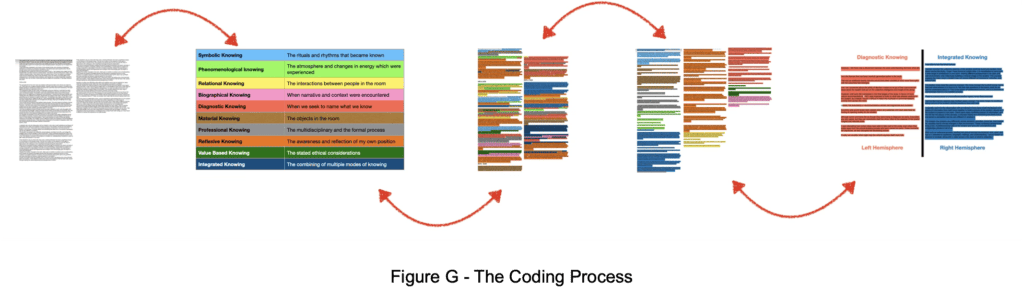
As this pattern became more apparent, a form of coding began to emerge. I recognised that different ways of knowing were making themselves visible through the way I was speaking and reflecting. From this process, I arrived at ten distinct ways of knowing (Figure A), which became the basis for my subsequent analysis. I then re-encountered my transcript and began to colour-code each sentence using these ten categories.
| Symbolic Knowing | The rituals and rhythms that became known |
| Phenomenological knowing | The atmosphere and changes in energy which were experienced |
| Relational Knowing | The interactions between people in the room |
| Biographical Knowing | When narrative and context were encountered |
| Diagnostic Knowing | When we seek to name what we know |
| Material Knowing | The objects in the room |
| Professional Knowing | The multidisciplinary and the formal process |
| Reflexive Knowing | The awareness and reflection of my own position |
| Value Based Knowing | The stated ethical considerations |
| Integrated Knowing | The combining of multiple modes of knowing |
The Emergence of a Polarity
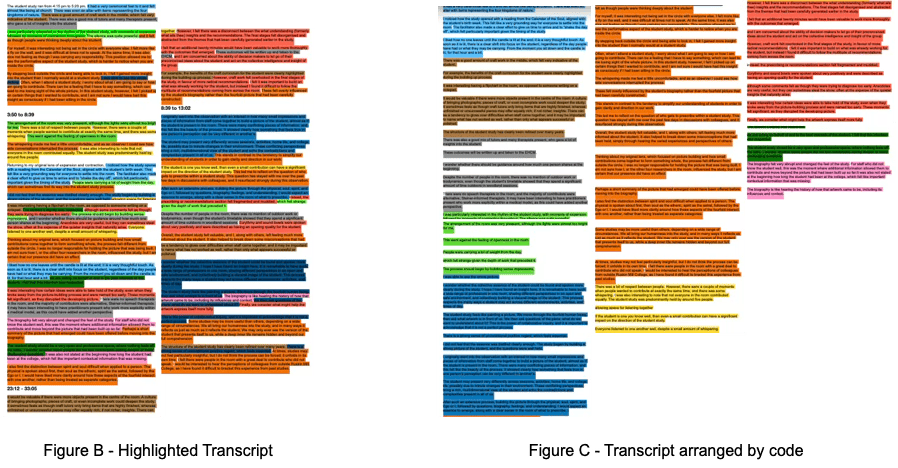
Once I had highlighted the codes within the transcript (Figure B), I reorganised the data by grouping sentences according to their respective categories (Figure C), aligning with Kiger and Varpio’s (2020) description of the transition from coding to theme development. Collating the data in this way enabled me to visualise how frequently I spoke from each mode of knowing. As anticipated, reflexive knowing was the most prominent category, as this had been my intended focus. What surprised me, however, was the extent to which diagnostic knowing and integrated knowing appeared throughout the transcript.
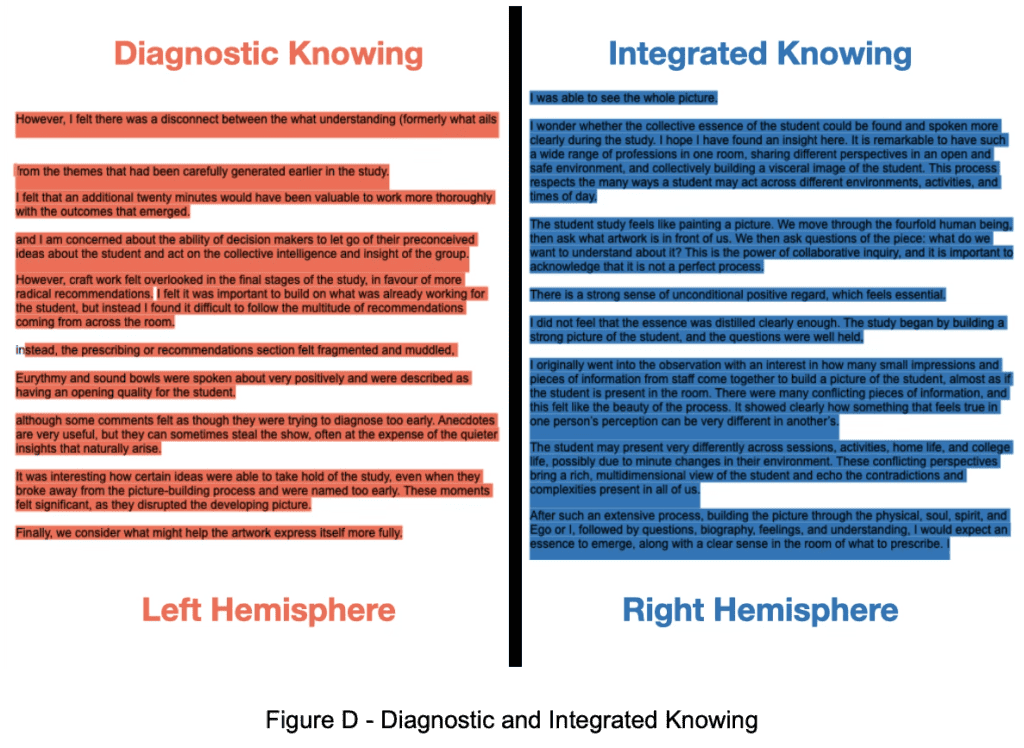
This led me into the fourth phase of thematic analysis, in which themes are reviewed and refined. As Kiger and Varpio (2020) note, “Themes can be added, combined, divided, or even discarded” (p. 851). In reviewing the themes, I chose to set aside several of the initial categories in order to focus more explicitly on the polarity between diagnostic knowing and integrated knowing (Figure D), which had emerged as the most conceptually significant tension within the data.
Ethical Considerations
As an insider researcher within Ruskin Mill College (RMC), I occupy a dual role as both colleague and researcher, which carries the possibility of bias. Having participated in many student studies previously, I practised bracketing in order to approach the observation with fresh eyes, resisting the tendency either to over identify with, or to be overly critical of, a process with which I am deeply familiar.
As my focus moves towards analysing what I term integrated and diagnostic modes of knowing, I do not seek to diminish the value of diagnostic knowledge in supporting students with SEND. Rather, I examine the timing and positioning of such knowledge within the student study, and how this may influence the process. In developing this argument, I draw on the work of Iain McGilchrist, as I see parallels between the two ways of knowing identified in this study and his distinction between the brain’s hemispheres. McGilchrist emphasises that the difference lies not in what the hemispheres do, but in how they attend to and interpret the world (McGilchrist, 2009). His argument that both hemispheres are necessary, yet must exist in the right relationship, provides a useful framework for considering the dynamic between these two modes of knowing within the student study.
The Findings
Through my thematic analysis of the data and the process I underwent (Figure G), I perceive a dance between diagnostic knowing and integrated knowing, both from my inner experience as a researcher in the room and from an outward perception of the student study.
Integrated knowing emerges through the picture building process of the student study, where the fourfoldness of the student is gradually built up through deep listening, self awareness, and a willingness to hold contradictions in perception.
Diagnostic knowing arises more acutely during the reading of the student’s biography and is experienced as a moment of contraction within the room. The biography interrupts the picture building process and shifts the inquiry toward a more diagnostic form of knowing. For staff members with little prior observation, lived knowledge of the student, the biography may become the primary takeaway, offering a diagnostic picture through which the student is understood. In this sense, the biography acts as a pivot point within the student study, shifting attention from an emergent picture of the student toward explanatory frameworks derived from the student’s past.
Diagnostic knowing then becomes a way of making sense of the student. We begin to harness the labels encountered in the biography, such as autism diagnosis, developmental delay, neglect, and other descriptors. Research suggests that diagnostic labels can influence how educators evaluate students, shaping expectations and interpretations of behaviour (Franz et al., 2023). Within the student study, it is therefore significant that the student’s biography is introduced immediately prior to the “understanding” phase of the process. At this point the study shifts from observation toward interpretation. Without careful facilitation, the diagnostic framing introduced through the biography may begin to guide perception, subtly displacing the integrated picture that had been slowly built through the earlier stages of the study.
With the biography we also bring the accumulated narrative of the student’s past. This narrative is constructed through information gathered from parents, carers, and EHCMs, condensed into a one page summary from birth to the present time at Ruskin Mill. Ruskin Mill seeks to support students in re imagining their potential and creating new stories for themselves. While this biographical account is important, it may also shape the expectations within the room. In subtle ways, the biography can constrain the emergence of the “new, imaginal and transformative picture” (Gordon & Cox, 2023, p.108) that the student study seeks to cultivate.
Formal risk assessments, care plans, and support strategies are already available for staff to consult. These documents naturally reflect the student’s biography and past experiences. Yet within the student study the biography occupies a central position at the moment the process shifts toward interpretation. If two student studies were held, one with a biography and one without, it would be interesting to observe the differing outcomes.
Drawing on the work of Iain McGilchrist (2009), this shift toward diagnostic framing may reflect a broader cultural tendency to privilege left hemispheric modes of attention. In this mode, understanding emerges through categorisation and explanation. By contrast, the earlier picture building process of the student study reflects a more integrative mode of attention, in which the student gradually emerges through relational and contextual understanding.
Diagnostic knowing tends to work with parts in order to form a whole, whereas integrative knowing seeks to perceive the whole before analysing its parts. RMT, drawing on Rudolf Steiner’s work, resonates strongly with this integrative orientation, emphasising phenomenology, holism, and re integration. Rudge (2010, pp. 126–127) writes: “Holists reject the notion of the world as being comprised of material building blocks, arguing that the world is comprised of networks of relations between parts and wholes. While the properties of the parts contribute to an understanding of the whole, the properties of the parts can only be fully understood through the dynamics of the whole.”
In the student study we are therefore building what could be described as an ecological understanding of the student. Bronfenbrenner argues that understanding a child requires consideration of the “entire ecological system in which growth occurs” (Bronfenbrenner, 1994, p. 37). From this perspective, development cannot be understood solely through diagnostic categories but must be viewed within the wider relational contexts in which the child lives and learns.
Knowledge generated during a student study should therefore include multiple layers of experience, drawing upon the collective observations of staff who interact with the student in different contexts. As Rudge (2010, p. 138) suggests, “using as many modes as possible for acquiring information and making judgments is more likely to result in judgments which are truer, in the sense that they will encompass more of the nature of Reality.”
Conclusion
It is the aim of a student study “to come to an understanding or ‘diagnosis’ of the young person’s condition from a PSTE perspective” (Gordon et al., 2025, p. 127). However, the student study does not approach diagnosis in the medical model sense. Instead, it follows a Goethean collective inquiry approach, “observing the person…in all its different modes of appearance rather than compartmentalising different dimensions” (Gordon & Cox, 2023, p. 165). Through the fourfold picture building process, a delicate picture of the student is collectively built up, to the point the students presence is often felt in the room.
Through my autoethnographic research, group work, and review of the literature, I suggest that the introduction of the student’s biography overrules the gradual unfolding of the study and makes the recommendations section less rooted in the collaborative inquiry of the study itself and more informed by diagnostically framed narratives within the student’s history. In this sense, the biography may draw the process toward a more diagnostic mode of understanding, resonating with a left hemispheric tendency to categorise and explain, rather than sustaining the open, integrative inquiry from which attuned insights have space to be realised, emerging from the threads formed through the study.
The inclusion of the biography changes the trajectory of the student study. The timing of its delivery within the structure of the study, and how it is communicated, are crucial. Further research is needed to deepen our understanding of how biographies influence perception within the student study, and how the phenomenological picture building process might be preserved alongside this knowledge.
References
Bronfenbrenner, U. (1994). Ecological models of human development. In International encyclopedia of education (2nd ed., Vol. 3). Elsevier. Reprinted in M. Gauvain & M. Cole (Eds.), Readings on the development of children (pp. 37–43). Freeman.
Ellis, C., & Bochner, A. P. (2000). Autoethnography, personal narrative, reflexivity: Researcher as subject. In N. K. Denzin & Y. S. Lincoln (Eds.), Handbook of qualitative research (2nd ed., pp. 733–768). Sage.
Franz, D. J., Richter, T., Lenhard, W., Marx, P., Stein, R., & Ratz, C. (2023). The influence of diagnostic labels on the evaluation of students: A multilevel meta analysis. Educational Psychology Review, 35(1), Article 17. https://doi.org/10.1007/s10648-023-09716-6
Gordon, A., & Cox, L. (2023). Place, craft and neurodiversity: Re imagining potential through education at Ruskin Mill (1st ed.). Routledge. https://doi.org/10.4324/9781003361541
Gordon, A., Gratton, T., Kippax, H., Court, C., Cox, L., Briggs, M., Courts, B., Griffiths, V., Hindmarsh, C., Rasmussen, S., Reakes, S., & Woods, J. (Eds.). (2025). Practitioner’s guide: Practical skills therapeutic education. Ruskin Mill Land Trust.
Kashikar, L., Lüke, T., & Grosche, M. (2026). Effects of diagnostic labels for students with learning problems on teachers’ stereotypes and performance expectations. Journal of Learning Disabilities, 59(1), 37–54. https://doi.org/10.1177/00222194251315187
Kiger, M. E., & Varpio, L. (2020). Thematic analysis of qualitative data: AMEE guide No. 131. Medical Teacher, 42(8), 846–854. https://doi.org/10.1080/0142159X.2020.1755030
McGilchrist, I. (2009). The master and his emissary: The divided brain and the making of the Western world. Yale University Press.
Nicol, J., & Taplin, J. T. (2017). Understanding the Steiner Waldorf approach: Early years education in practice (2nd ed.). Routledge.
Rudge, L. (2010). Holistic education: An analysis of its pedagogical application. University of Bath.
Shakespeare, T. (2013). Disability rights and wrongs revisited. Routledge.
Steiner, R. (1919, August 28). Lecture VII. In The study of man (GA 293). Rudolf Steiner Archive. https://rsarchive.org/Lectures/GA293/English/RSP1966/19190828a01.html
The Spiritual Scientist. (2025, November 17). The hidden power of craft, land & community: Ruskin Mill’s Steiner inspired education (Interview with Aonghus Gordon) [Video]. YouTube. https://www.youtube.com/watch?v=X4lVPwNUSlA. Retrieved March 9, 2026.
Wiechert, C. (2019). Solving the Riddle of the Child : The Art of Child Study (M. Barton, Trans.). Verlag am Goetheanum.
Wiehl, A., Auer, W.-M., Saar, M. M., & Waldorf Early Childhood Association of North America, publisher. (2020). Understanding child development : Rudolf Steiner’s essential principles for Waldorf education (A. Wiehl & W.-M. Auer, Eds.; M. M. Saar, Trans.). Waldorf Early Childhood Association of North America.
Recent Posts
What Artifical Fertilisers Do to the Soil: Insights from Alex Podolinsky
“Plants should take in elements via humus and not through the soil water” - Rudolf SteinerIn the Agriculture Course, Steiner speaks of the soil becoming deaf to the forces of the cosmos....
In old times, humanity had an instinctive relationship with the cosmos, and agriculture was conducted with deep reverence for these rhythms. The peasant farmer was deeply attuned to them.“Let...