
In old times, humanity had an instinctive relationship with the cosmos, and agriculture was conducted with deep reverence for these rhythms. The peasant farmer was deeply attuned to them.
“Let us consider a simple farmer, whom a learned person would regards as ignorant, walking over his fields. The learned person of course, would say that this simple farmer is stupid, but this is not really true; because this farmer – forgive me for saying this but it is so – is actually a mediator… and is attuned to acquiring spiritual knowledge”
(Lecture 3, The Agriculture Course, 1924)
“One is amazed to find how much the peasant knows of what is actually going on in Nature. It is no longer possible today to write such a “Peasant Philosophy”—too much of the real thing has been lost” (Lecture 4, The Agriculture Course, 1924)
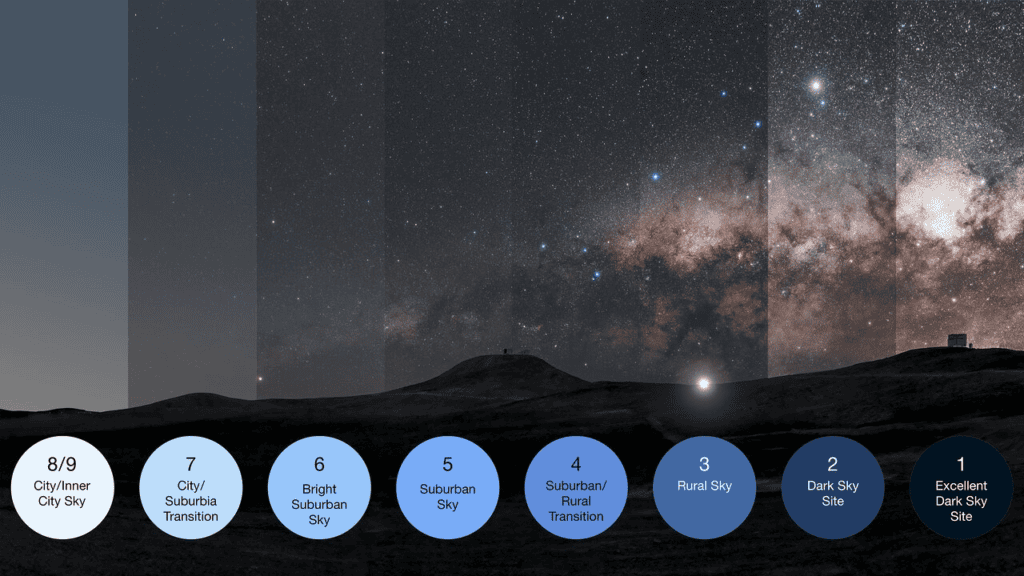
With modernity, this deep connection to the cosmos has been severed. Today, we battle against light pollution to even be able to see the constellations in the night sky. In cities, only a handful of constellations are visible. Many of us have lost our access to this great cosmic spectacle, and our leaders, based in capital cities around the world, can no longer consult the stars when making decisions that impact us all. How deranged may our ideas of the world become if we fail to see our connection to the cosmos above?
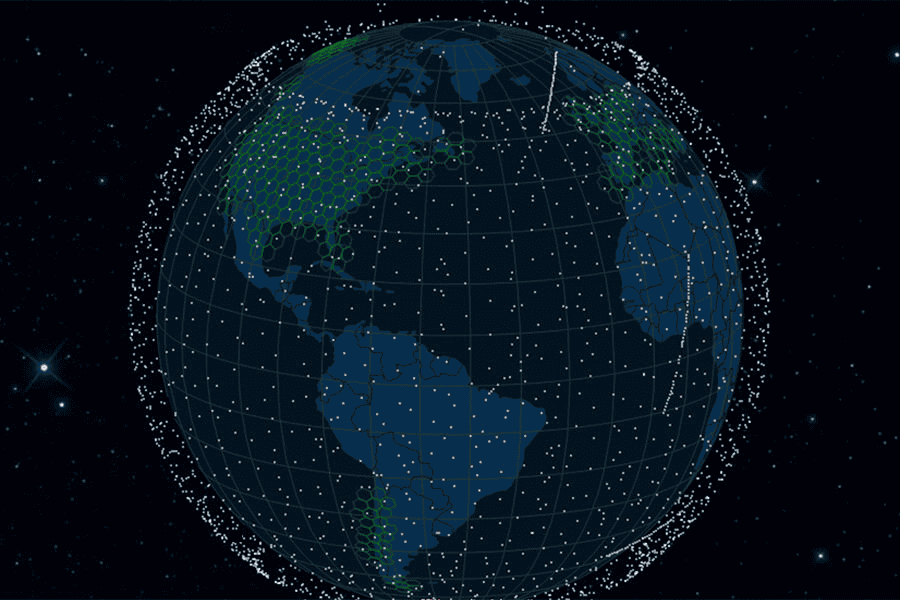
Light pollution is set to double every eight years, disrupting this connection further and severing any ties our children will have to the stars. Furthermore, satellites continue to launch at an accelerated speed to fulfil our unquestionable thirst for technology, at the cost of further disorientating ourselves from our place in the cosmos. In the next few years, there will be above 50,000 satellites, all reflecting back the sunlight to us and breaking the patterns and shapes of the constellations.
With biodynamics, we are working to rekindle this connection to the cosmos through our work in our gardens and on our farms. We understand that the Moon was once part of the Earth, and its rhythms have an influence over the natural world, our plants, animals, and ourselves. The influences of the Moon on nature are well-documented by science and accepted. Biodynamics works with these lunar rhythms, but also brings in the influences of the whole solar system and the fixed stars of the zodiac, which bring other subtle forces.
In this article, I want to take you on a journey from the Agriculture Course given by Rudolf Steiner in 1924, to the research undertaken by Lili and Eugen Kolisko, then to the further research of Maria Thun, and finally to the indications and ideas of the Maria Thun Biodynamic Calendar.
Rudolf Steiner’s Indications
“When the Moon was still united to the Earth, the Earth was much more alive, much more fertile. Its substances were not yet so mineralised within it. But since the Moon has separated from the Earth, it strengthens those forces of the Earth which by themselves are just sufficient to produce growth on earth in such a way that growth is enhanced to reproduction. “
“As I said before, people look upon the Moon as simply reflecting the rays of the Sun, as transmitting solar light. But that is not the only thing which reaches the Earth. Together with the Moon’s rays, the entire cosmos is reflected upon the Earth.”
“It is impossible to-day to obtain such fine potatoes as I remember eating in my youth? It is impossible to find such potatoes even in the districts in which they used to be grown. (It is really so! I have tested them everywhere!)
The nutritive forces of certain foods have actually declined over a passage of time. The last decade shows this quite distinctly. The reason is that we no longer understand the intimate forces at work in the whole cosmos.”
“If something to be grown is placed in the soil at new Moon instead of at full Moon, it will wait until the Moon is again at the full, and, regardless of human error, work in accord with Nature. Thus, men make use of the Moon without having the least idea that they are doing so.
The Moon promotes the reproductive forces of all living plants, that it creates the force which pushes upwards through the plant from the root right on into the seed as it is being formed in the fruit.”
Lili Kolisko’s Research
Lili Kolisko (1889–1976) was a pioneering biodynamic researcher whose life was marked by both scientific devotion and personal hardship. Alongside her husband, the respected anthroposophic doctor Eugen Kolisko, she undertook groundbreaking experimental work inspired by Rudolf Steiner’s indications.
Amid serious disagreements with influential members of the Anthroposophical Society, the couple left Germany in the 1930s and resettled in England. Not long after their move, Eugen died suddenly of a heart attack, leaving Lili to continue her work alone. Living in extreme poverty — at one point supporting herself by sewing purses — she nonetheless persisted in her meticulous research, laying important foundations for later biodynamic studies.
“In 1924 Rudolf Steiner, … intrusted me personally with the task of making all the necessary scientific investigations in connection with his Agricultural Course. Since 1924 I have studied all his suggestions for regenerating Agriculture.
Rudolf Steiner meant his suggestions for the whole world, not for a small group of privileged farmers. Only a real understanding of the wonderful organism ‘Agriculture’ will make it possible to grow healthy food”
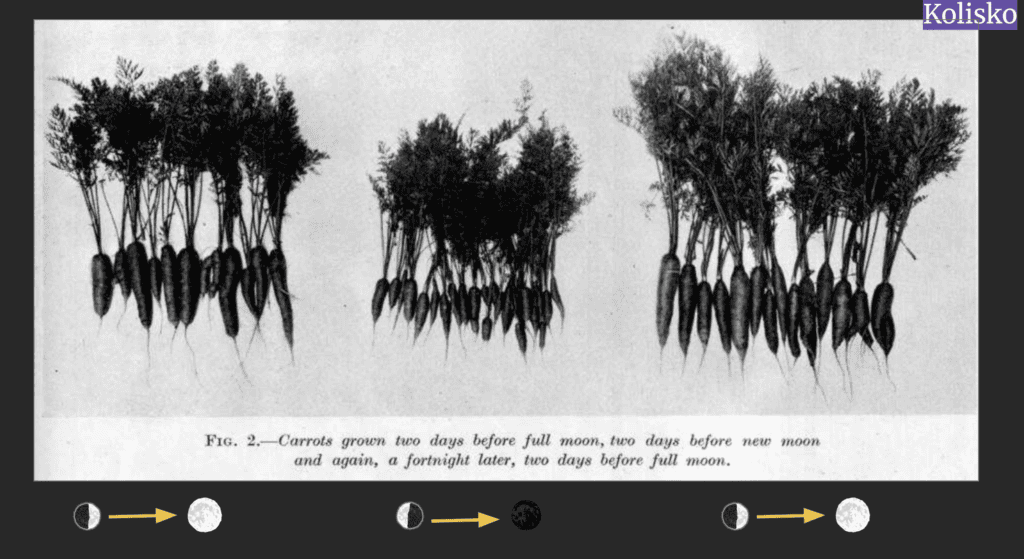
“The maximum growth is always reached during the waxing moon-period, from new moon to full moon. That seems to be a law.
These experiments showed very clearly which were the most favourable days during the year. The best results, the biggest plants, we found nearly always two days before full moon, sometimes three or four days before full moon.
These experiments started in 1926 with maize. The seeds were sown 2 days before full moon, according to a suggestion of Rudolf Steiner; and the experiment was repeated a fortnight later, 2 days before new moon. The seeds sown 2 days before full moon sprouted very quickly, and strong, healthy plants developed. The seeds sown 2 days before new moon needed longer to sprout and developed very poorly.”
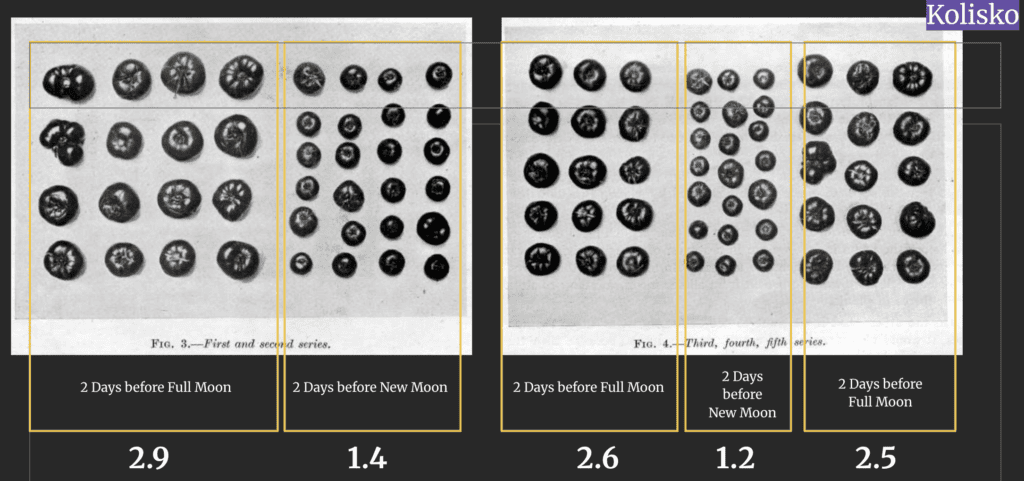
The weight of a single tomato sown two days before full moon was between 280 and 350 grams (9-12 oz.); of a single tomato sown two days before new moon 120-180 grams (4-6 oz.).
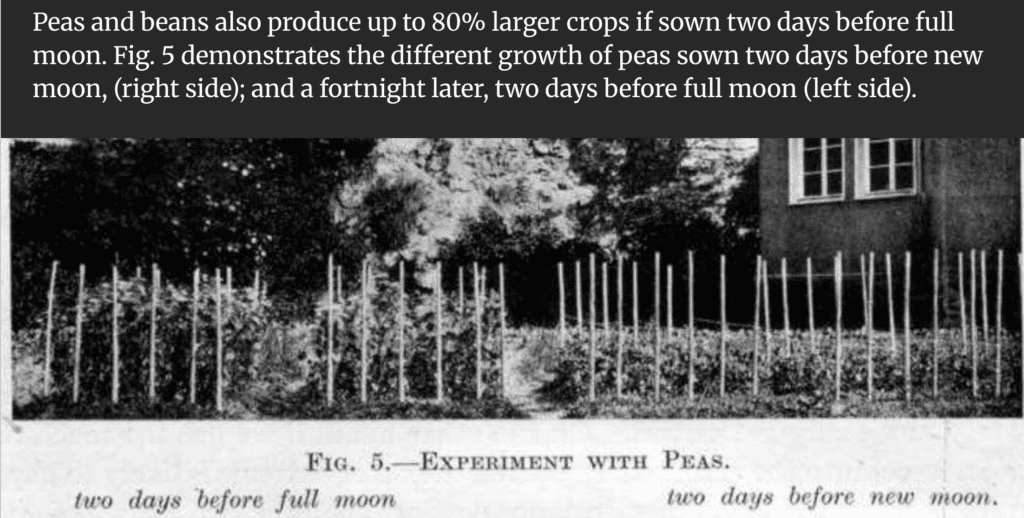
“Seeds sown two days before full moon push through the soil very quickly in a few days time. Seeds sown two days before new moon take a much longer time. In most cases we find that those seeds wait in the soil for the next waxing moon.
At full moon the forces of the moon are just beginning to decrease. Two days before the moon is full, we are in a stream of energy striving towards the maximum strength. It is therefore necessary to sow two or three days before the moon is full if we want to benefit from all the moon can allow to stream into the life-forces of plants.”
The Carrot Taste Test
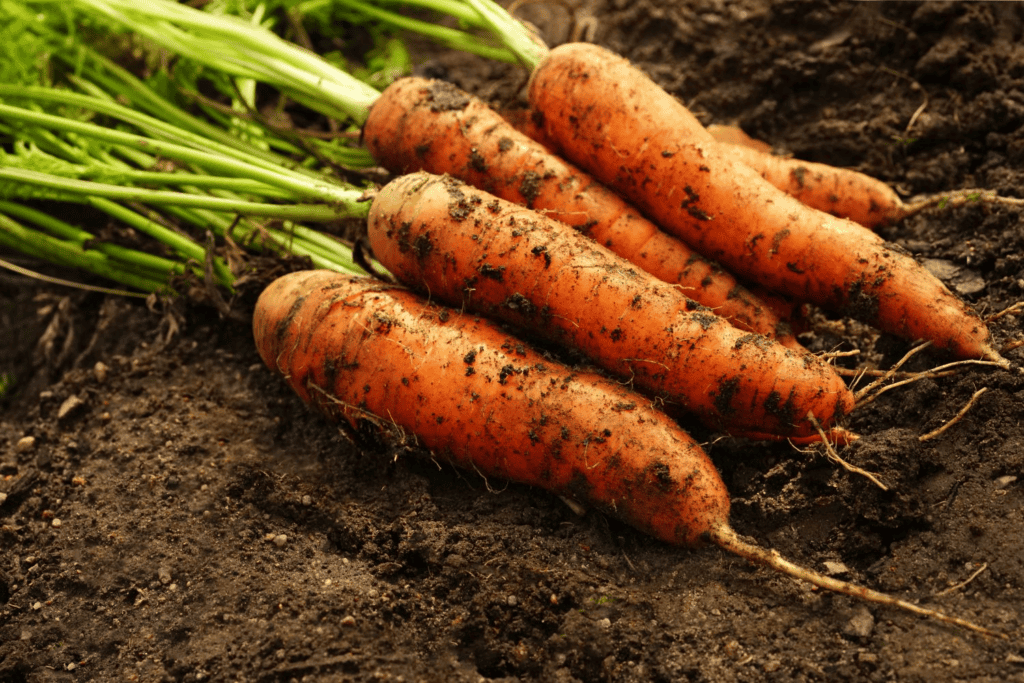
“Cut them with a knife and watch the surface. The full moon carrot becomes watery immediately after cutting. And the new moon carrot remains dry. Now, if you taste, you will find a rather sweet, mild flavour in the full moon carrot, and a more bitter and sharp taste in the new moon carrot.
Looking carefully at the skin of the carrot, you notice that full moon carrots have a smooth surface; the new moon carrots are often wrinkled and shrunken. This is a sign, that the one is fully penetrated by the watery element, and that the other is more dry; this is connected with the difference in taste.
It seems to be a natural law that full moon forces bring more of the watery element into the fruits.”
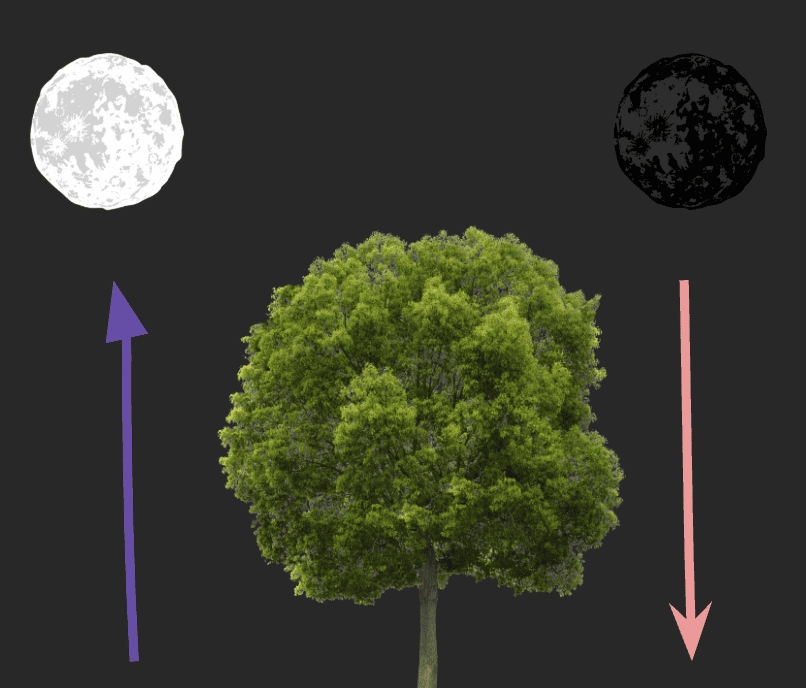
Cutting Trees With The Moon
“During the full moon, the tree is full of growing energy sap and it is almost impossible to get the wood dry if the wood is cut during this period, and the wood cannot be used for working purposes; it is not even of much use for fuel. But when trees are cut during the waning moon, then the wood gets dry easily and can be used for furniture-making and other purposes.”
“It can be proved with many experiments, demonstrated in the previous chapters, that the moon influences plant growth. Nobody doubts the influence of the sun. Is there any possibility of proving that other planets also influence plant life?
For instance in the red rose, we see the forces of the planet Mars: in blue flowers the force of Saturn; and in white and yellow flowers the forces of the planet Jupiter.”
Maria Thun’s Research
Maria Thun (13 April 1922 – 9 February 2012) was a German biodynamic researcher best known for developing the biodynamic sowing calendar through decades of practical field trials. Her work explored how lunar and planetary rhythms influence plant growth and continues to shape biodynamic agriculture worldwide. She experimented for 60 years with the lunar and planetary rhythms.
| Planets and Sun | Element | Constellation |
| Saturn, Mercury, Pluto | warmth | Aries, Leo, Sagittarius |
| Sun | earth | Taurus, Virgo, Capricorn |
| Jupiter, Venus, Uranus | air/light | Gemini, Libra, Aquarius |
| Moon, Mars, Neptune | water | Cancer, Scorpio, Pisces |
Maria Thun looked into the planets and their relationships to the constellations of the zodiac and to the elements. For example, when Jupiter is in the constellation of Gemini, it brings the element of air/light to the Earth. Or if Saturn is in a fire constellation such as Aries, it will create an affinity for warmth. These planetary rhythms complement the lunar rhythms that are of great importance when working with plants, and they can also influence weather conditions.
In biodynamics, we are working with a great deal of different rhythms; there is never a repeat — the cosmos is new at every moment.
“A comparison of the two schemes revealed that certain lunar forces, depending on the Moon’s position in the zodiac, stimulated one of the four etheric forces and affected the plants through the elements: earth, water, air, and warmth.
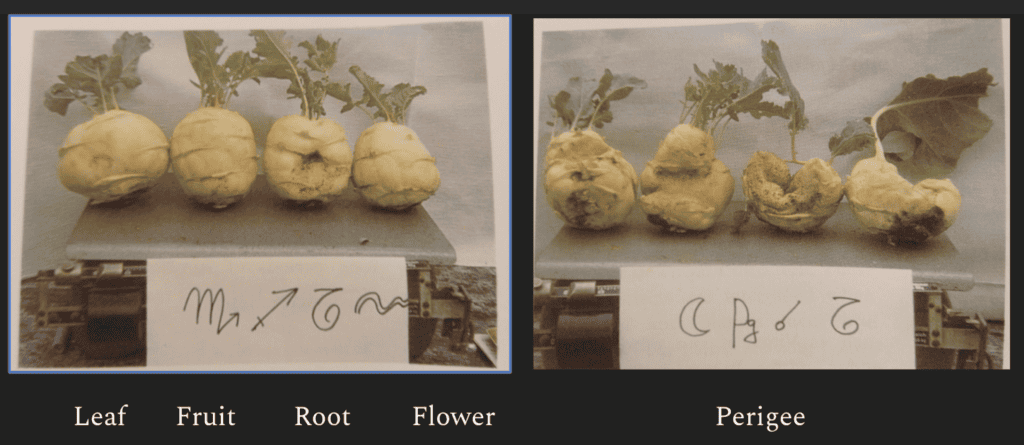
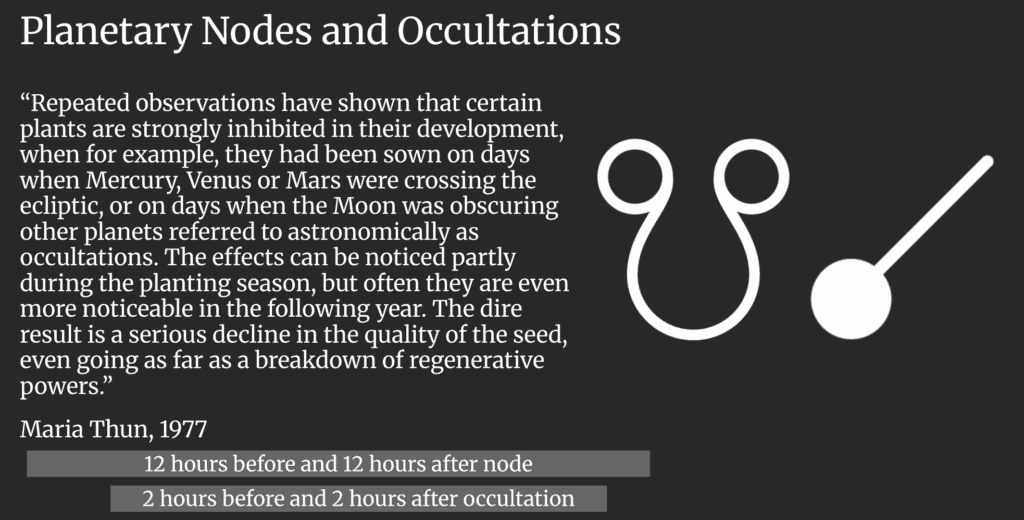
We then sought to understand the cause of the growth inhibitions observed on particular days and during specific periods. We came to the conclusion that perigee consistently had an unfavourable effect, as did the Moon’s node at certain times. Planetary oppositions also altered the plant type. For example, the opposition of Venus and Jupiter in March 1957 stimulated strong flower development.”
“The same plant developed in markedly different ways. One produced a strong root (tuber) but only small leaves — a root type. Another formed large leaves with a relatively small root — a leaf type. A third developed leaves on a red stem and hurried toward stem and flower formation, yet remained in this state for a long time with only a trace of a tuber — a flower type. A fourth seemed almost to omit tuber formation altogether, rushing through leaf and flower development to produce seeds and ensure reproduction — a fruit/seed type.”
“The fourfold nature of the plant became evident.”
“Suddenly, I found myself confronted with the discovery of a basic law of plant formation. Did the first cultivators have an insight into this law? The recognition of this fourfold organisation was an unexpected reward for many years of work.”
Root Crops
“Root crops sown with the Moon in Taurus, Virgo, and Capricorn developed the best yields. They were of high quality and good flavour, with relatively small growth above ground.
Root crops sown on Leaf days produced strong leaf development but small roots and did not store well. When kept in the cellar, they shrivelled early in winter. By contrast, root crops sown on Root days kept much longer.”
Leafy Crops
“Leafy crops such as spinach, lettuce, lamb’s lettuce, cress, and cabbage thrived best when sown with the Moon in Pisces, Cancer, and Scorpio. These plants developed abundant foliage and remained in the leaf stage for an extended period without progressing quickly to flower and seed.”
Fruit Crops
“The observation of fruit plants confronted us with new mysteries. It turned out that Aries and Sagittarius were favourable for the development of the flesh of cucumbers, tomatoes and beans, but were not favourable for peas and broad beans.
Peas and broad beans sown when the Moon was in Leo led to the best harvest.
Sowings of cucumbers, tomatoes and beans developed very rapidly initially and formed small fruit with big seeds.”
Flower Crops
“Sowings on Leaf days (Pisces, Cancer, Scorpio) resulted in vigorous leaf growth but difficulty forming flowers.
Sowings on Fruit days (Aries, Leo, Sagittarius) produced sparse growth with few leaves and rapid development toward flowers and seed.
Flower plants flourished best when sown with the Moon in Gemini, Libra, and Aquarius. These plants developed many branches, numerous flower buds, and remained in the flowering stage for a prolonged period. When flowers were cut, the plants readily produced new side shoots, and flowering was abundant.
Flower plants sown on Root days showed poor growth above ground and produced very few flowers.”
The Zodiac and the Moon
“The zodiac, as it has been called since ancient times, is the belt of stars in the sky in front of which the ecliptic runs, and in front of which all the planets of our solar system move on their paths.
The influences or radiations of the zodiacal constellations are disturbed by the passing planets, which results in an interruption, weakening or strengthening of their influence, which is reflected in plant growth or in weather formation.
When the Moon travels past the different constellations on its orbit around the Earth we find:
Pisces, Cancer and Scorpio have a tendency to the watery element.
Aries, Leo and Sagittarius have a tendency to the warmth element.
Taurus, Virgo and Capricorn have a tendency to the Earth element (cold tendency).
Gemini, Libra and Aquarius have a tendency to the airy and light element.”
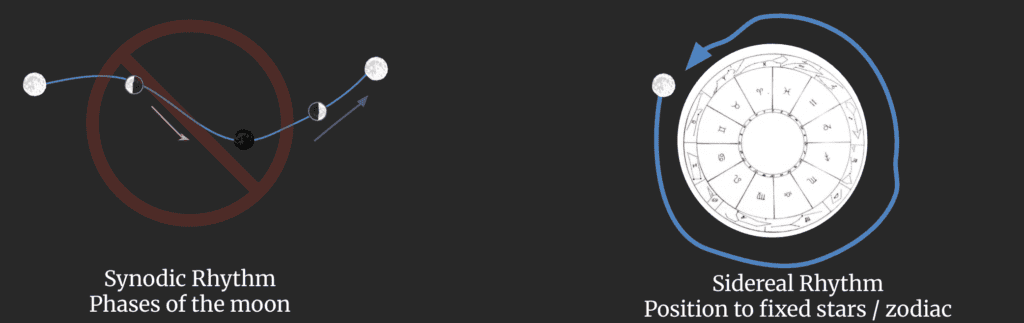
With the insights of Rudolf Steiner and the research of Lili Kolisko, we have a synodic understanding of how the plant is influenced by the phases of the Moon. Planting a seed two days before the full Moon will help the plant to grow with vitality, whereas planting before the new Moon, the seed will lack the pull of the Moon.
Maria Thun’s research moves away from this synodic rhythm and instead deals with the sidereal rhythm, where the position of the Moon in relation to the zodiac has the greatest influence on the plant. This may be viewed as a contradiction, and it can be difficult to reconcile these ideas. Therefore, it is recommended that every keen biodynamic grower does their own research and comes to their own understanding of how the Moon influences their work.
“The synodic month does not have much effect on plant growth, and we take no account of it in this calendar; the phases are merely shown for those people who want to have a complete picture of the moon’s rhythms” – The Maria Thun Biodynamic Calendar
Old Farmers Almanac
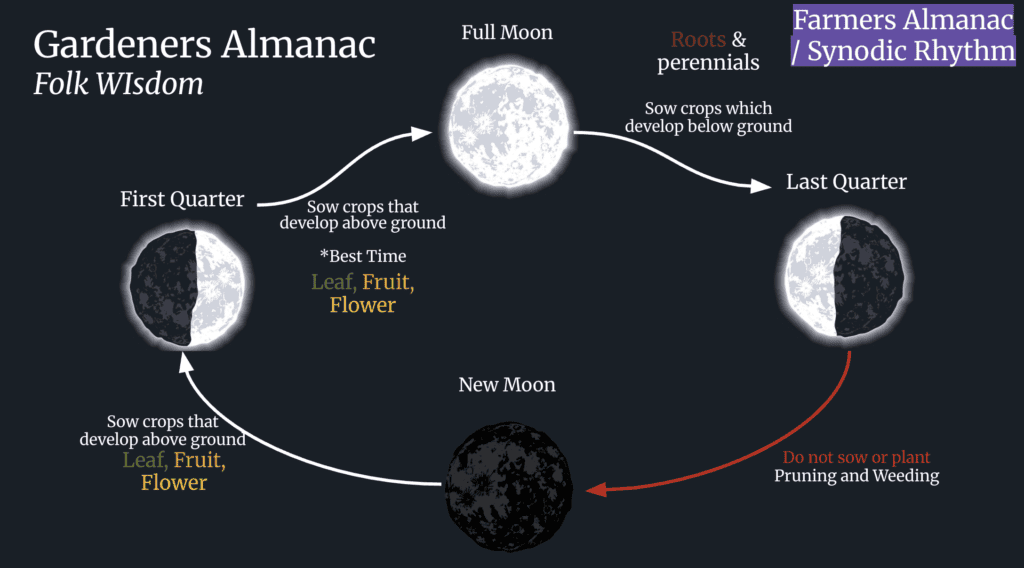
Before we look into the Maria Thun Biodynamic Calendar and its sidereal rhythm, we must briefly look at the Farmers’ Almanac, which continues to incorporate a synodic rhythm, while now also bringing the fourfold nature of the plant into its calendar.
The Old Farmer’s Almanac was first published in 1792 in the United States and has appeared every year since. Its planting calendar is based largely on the phases of the Moon, following the traditional belief that the Moon influences moisture in the soil, much as it affects the tides. According to this system, crops that bear above the ground are best planted during the waxing Moon (from new Moon to full Moon), when energy and moisture are thought to be rising, while root crops are favoured during the waning Moon (from full Moon to new Moon), when forces are believed to draw downward.
Over time, the Almanac has incorporated regional frost dates and long-range weather forecasting, but the core lunar planting method has remained relatively consistent. This approach works primarily with the synodic lunar cycle — the visible phases of the Moon — and does not generally take into account the Moon’s position in the zodiac or the broader planetary relationships that are central to biodynamic agriculture.
The Maria Thun Biodynamic Calendar
The Maria Thun Biodynamic Calendar is an annual agricultural calendar based on decades of experimental research carried out by Maria Thun. Its central principle is the sidereal rhythm of the Moon — meaning the Moon’s position in front of the constellations of the zodiac — rather than simply its visible phases. Through systematic sowing trials, Thun observed that when the Moon passes through certain zodiac constellations, different parts of the plant are stimulated.
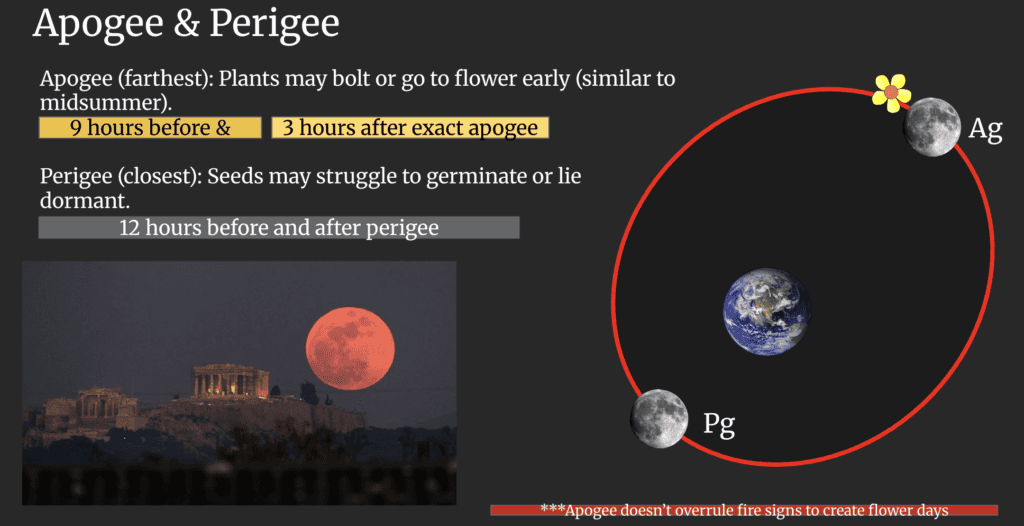
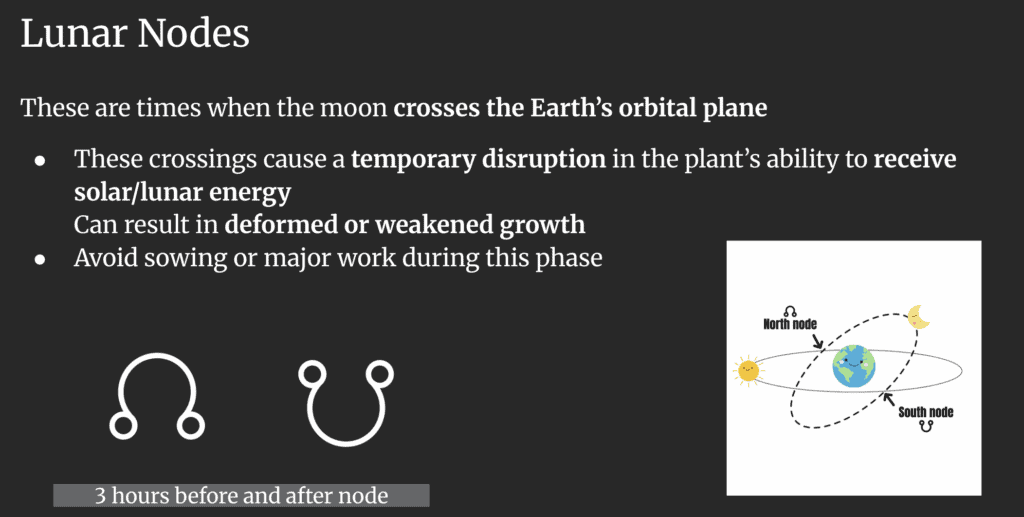
Beyond this core sidereal rhythm, the calendar also indicates additional lunar events such as ascending and descending Moon, apogee and perigee, lunar nodes, and planetary aspects. These moments are considered to intensify, weaken, or disturb plant growth processes.
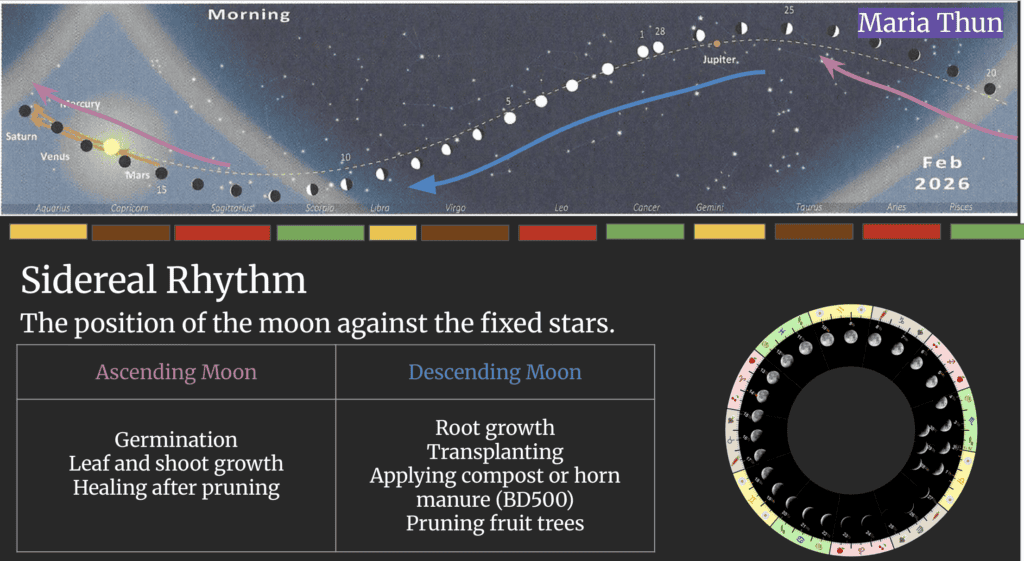
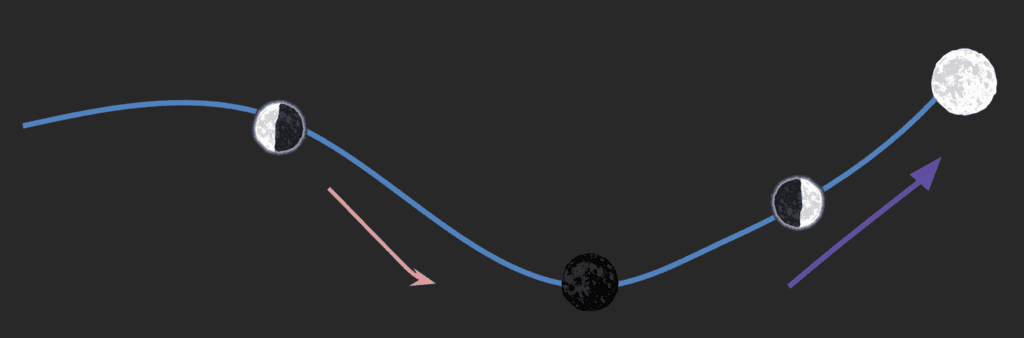
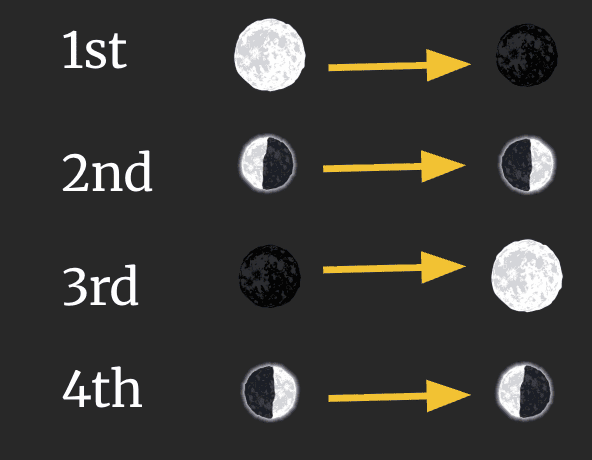
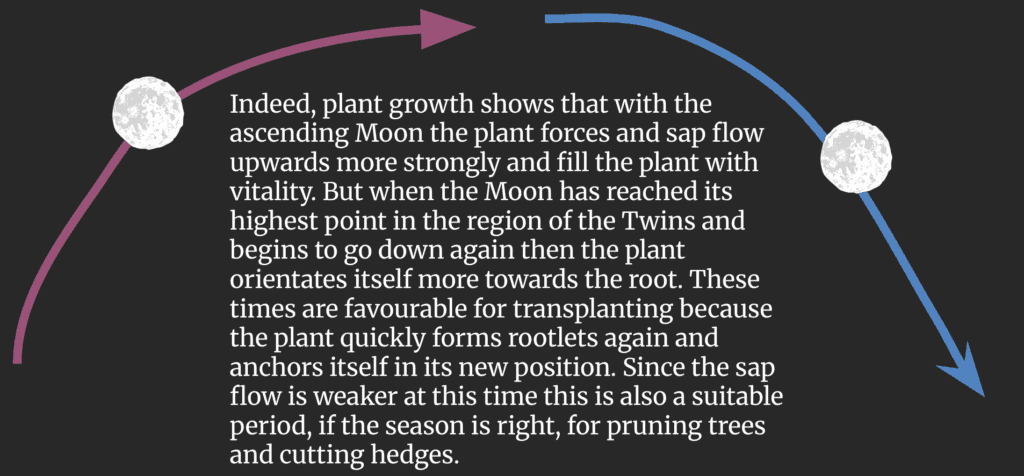
The calendar considers the ascending and descending Moon to influence the development of a plant. For half the month, the Moon appears to rise and reach a higher zenith each day, and then it descends to a lower point each night for the following two weeks. This gives us our transplanting time when the Moon is descending, and our ascending Moon period, when the forces of the Moon are working above the soil.
This differs greatly from the synodic calendar, where the waxing and waning of the Moon correlate with an ascending and descending gesture.
Several years ago, there was growing interest and even a wave of hype around the Maria Thun Biodynamic Calendar within the wine industry. Some major UK supermarkets began experimenting with its indications to guide wine tastings. Tesco and Marks & Spencer — which together sell a significant proportion of Britain’s wine — invited critics to taste wines on days the calendar identifies as “fruit” days, when wines are believed to show at their best, while avoiding “root” and “leaf” days.
Pierpaolo Petrassi, Tesco’s senior product development manager, explained: “Our first choice is a fruit day. We seek to avoid root and leaf days.” Similarly, Jo Ahearne, winemaker for Marks & Spencer, said that after tasting over 140 wines across different lunar days, “the difference between the days was so obvious I was completely blown away.” Even a Guardian test found that most bottles tasted showed noticeable improvement on a fruit day compared to a leaf day — suggesting that biodynamic rhythms may influence not only how plants grow, but how their finished products are experienced.
The Symbols
☉ Sun — The central body of the solar system; the Earth orbits the Sun in 365 days, forming the basis of the solar year and seasonal rhythm.
☾ Moon — Orbits the Earth in 27.3 days (sidereal) and completes a phase cycle (new Moon to new Moon) in 29.5 days (synodic); the foundation of biodynamic timing.
☿ Mercury — Orbits the Sun in 88 days.
♀ Venus — Orbits the Sun in 225 days.
♂ Mars — Orbits the Sun in 687 days (about 1.9 years).
♃ Jupiter — Orbits the Sun in 11.86 years (about 12 years).
♄ Saturn — Orbits the Sun in 29.5 years (about 30 years).
♅ Uranus — Orbits the Sun in 84 years.
♆ Neptune — Orbits the Sun in 165 years.
♇ Pluto — Orbits the Sun in 248 years.
♈ Aries — Fire element; associated with fruit and seed development in plants.
♉ Taurus — Earth element; associated with root development.
♊ Gemini — Air/Light element; associated with flowering processes.
♋ Cancer — Water element; associated with leaf growth.
♌ Leo — Fire element; associated with fruit and seed development.
♍ Virgo — Earth element; associated with root development.
♎ Libra — Air/Light element; associated with flowering processes.
♏ Scorpio — Water element; associated with leaf growth.
♐ Sagittarius — Fire element; associated with fruit and seed development.
♑ Capricorn — Earth element; associated with root development.
♒ Aquarius — Air/Light element; associated with flowering processes.
♓ Pisces — Water element; associated with leaf growth.
Pg — Perigee; the Moon at its closest point to Earth, often considered an intensification of lunar influence.
Ag — Apogee; the Moon at its furthest distance from Earth, sometimes linked to light-like or flowering qualities.
↗ Ascending Moon — Over roughly two weeks, the Moon rises higher in the sky each day, associated with forces working above the soil.
↘ Descending Moon — Over the following two weeks, the Moon sinks lower in the sky each day, associated with transplanting and root-related work.
☊ Ascending Node — The point where the Moon crosses the ecliptic moving northward; often considered a time of disturbance in plant growth.
☋ Descending Node — The point where the Moon crosses the ecliptic moving southward; likewise regarded as a disruptive period.
☌ Conjunction — Two celestial bodies aligned at 0°, appearing together in the sky.
●☌ Occultation — A stronger form of conjunction where the Moon passes directly in front of a planet or bright star, temporarily obscuring it.
☍ Opposition — Two bodies positioned 180° apart.
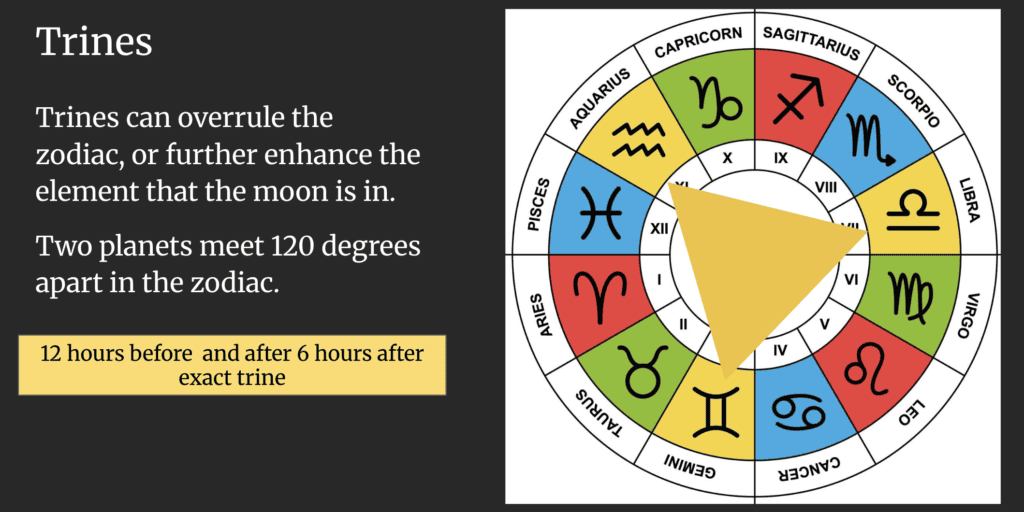
△ Trine — A 120° relationship, generally considered harmonious.
□ Square — A 90° relationship, often associated with tension.
✶ Sextile — A 60° relationship, generally considered supportive.
☉☾ Solar Eclipse — The Moon passes in front of the Sun at a lunar node.
☾☉ Lunar Eclipse — The Earth’s shadow falls upon the Moon at a lunar node.
Recent Posts
What Artifical Fertilisers Do to the Soil: Insights from Alex Podolinsky
“Plants should take in elements via humus and not through the soil water” - Rudolf SteinerIn the Agriculture Course, Steiner speaks of the soil becoming deaf to the forces of the cosmos....
Introduction Lecturing on the introduction of public libraries across Britain in the mid‑nineteenth century, John Ruskin reflected on the many letters he received from parents concerning...